CONGRATS! YOU EARNED FREE SHIPPING.

Product Title
1
$0
$0
Subscription Title

Looking kind of empty in here.
We recommend:
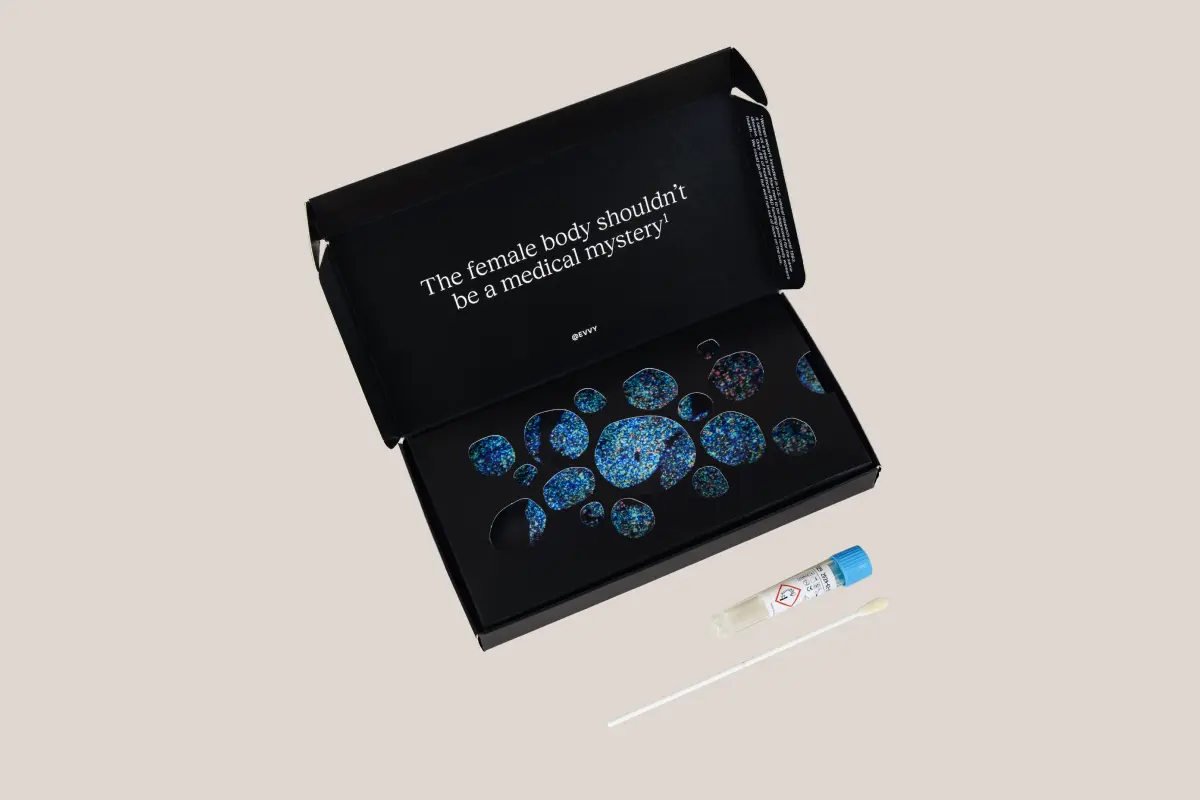
Get advanced insights into symptoms, fertility, and other health outcomes. Prelim results in 1-3 days.

New research shows BV isn't one condition — it's many. Learn the different types of BV, what bacteria drive each, and how to test your microbiome.
Words by Olivia Cassano
Scientifically edited by Pita Navarro
Medically reviewed by Dr. Kate McLean MD, MPH, FACOG
If you have been told you have bacterial vaginosis (BV), you might assume it is a single, straightforward infection. New research from Evvy shows that BV isn’t one condition, but a spectrum of distinct microbial states that can look identical on a standard test but behave very differently in the body.
For decades, BV has been used as an umbrella term for an “overgrowth of bad bacteria,” even though that overgrowth can look very different from person to person. That’s part of why BV so often comes back after treatment, leaving many women (and doctors) wondering why it’s so hard to get rid of for good.
Using DNA sequencing data from over 100,000 vaginal microbiome samples, Evvy's researchers identified multiple BV subtypes, each with its own bacterial makeup, symptom pattern, and treatment implications.
Ready to find out which subtype you have? Evvy's at-home Vaginal Microbiome Test gives you species-level DNA sequencing of your vaginal microbiome, plus your specific BV subtype if applicable.

Recurrent symptoms? Get Evvy's at-home vaginal microbiome test, designed by leading OB-GYNs.
Bacterial vaginosis is a vaginal microbiome imbalance — one in which protective Lactobacillus bacteria drop off and other bacteria overgrow. So, how many types of BV are there? Evvy’s research has identified six so far.
Different people can have the same diagnosis but very different bacteria driving their symptoms, which goes a long way toward explaining why the same treatment works for one person and does nothing for another.
Some of those bacteria, like Gardnerella vaginalis, have been studied for decades. Others are less well understood, and some won't even show up on a standard swab test. Knowing which bacteria are behind your BV is the first step toward figuring out why it keeps coming back and what might actually help.
.jpg)
BV occurs when the vaginal microbiome becomes imbalanced. In a healthy vaginal environment, protective Lactobacillus bacteria help maintain a stable, acidic environment. In BV, those protective bacteria drop, and other bacteria overgrow. While this general pattern has been understood for decades, the way BV is diagnosed has not kept up with modern microbiome science.
BV is still diagnosed using tools that were created before we could see the vaginal microbiome in detail. Most providers rely on Amsel's criteria or the Nugent score:
Both are useful for confirming that BV is present, but neither of them shows which specific bacteria are driving the imbalance, or how different one person's BV may be from another's. The result is very different microbial patterns grouped under the same diagnosis and treated as if they were the same condition.
That lack of detail matters clinically. People with BV don't all have the same vaginal symptoms, the same recurrence patterns, or the same response to treatment. Some improve quickly but relapse within weeks, while thers experience longer stretches without symptoms. These differences suggest that the different BV bacteria behave differently, and that treating BV as one uniform condition is likely why outcomes are so inconsistent.
By applying high-resolution DNA sequencing to vaginal microbiome samples, Evvy's researchers identified several distinct microbial patterns within BV. These are not separate conditions, but rather different versions of the same diagnosis, each with its own bacterial makeup and behavior. Here is what Evvy's research found:
This is what most people picture when they think of BV — the classic BV presentation, defined by low levels of protective Lactobacillus and an overgrowth of BV-associated bacteria. Typical BV is often linked to the symptoms that prompted someone to seek care in the first place: a fishy or musty odor, grey or white vaginal discharge, and sometimes mild irritation.
This subtype generally responds to first-line antibiotic treatment (metronidazole or clindamycin), though recurrence remains common. The fact that so many people experience multiple BV episodes even after a confirmed-effective round of antibiotics points to the complexity beneath this seemingly straightforward presentation.
The vaginal microbiome is not static. It shifts in response to hormones, sexual activity, menstruation, medication, and more, and sometimes it sits in an in-between state rather than a clearly defined one.
Transitional BV describes a microbiome that is shifting. Protective and disruptive bacteria are coexisting, and the microbiome may be moving into or out of a full BV state. People with this subtype may not have textbook BV symptoms or may notice that symptoms come and go. Identifying this pattern is useful because early intervention (whether through probiotics, lifestyle changes, or targeted treatment) may help prevent the microbiome from tipping into typical BV.
While standard BV involves an overgrowth of anaerobic bacteria, some people have a more complex pattern that includes both BV-associated bacteria and other disruptive microbes — particularly those associated with aerobic vaginitis (AV), a distinct condition caused by aerobic bacteria like Escherichia coli or Streptococcus agalactiae.
Mixed BV tends to be harder to treat than a 'pure' BV subtype because the bacterial communities involved respond to different treatments. What clears the anaerobic bacteria may not address the aerobic component, which is why some people feel only partially better after a standard course of antibiotics.
Lacto-dominant BV might seem like a contradiction: how can you have BV if Lactobacillus is still dominant? The answer lies in what kind of Lactobacillus is present, and in what else is living alongside it.
In this subtype, Lactobacillus levels are relatively high, but BV-associated bacteria are also present and detectable. This pattern highlights that dominance alone does not guarantee protection. People with lacto-dominant BV may be subclinical (without obvious symptoms) or may experience intermittent symptoms that do not fit the typical BV profile.
Biofilm BV is defined not by which bacteria are present, but by how they behave. In this subtype, bacteria — most commonly Gardnerella, often alongside other species — form structured, multi-layered communities that adhere to the vaginal lining. These biofilms act as a physical barrier, making it significantly harder for antibiotics to penetrate and eliminate the infection.
Research has identified biofilm formation as one of the central mechanisms behind recurrent BV. Even when antibiotic treatment is successful at reducing symptoms, bacteria embedded within the biofilm can survive and repopulate the vaginal environment, often within weeks of treatment ending. People with biofilm BV typically experience a persistent cycle of infection despite repeated antibiotic courses.
Not every BV case fits neatly into one of the more commonly characterised subtypes. Atypical BV describes cases driven by less well-characterised anaerobic bacteria, species that may not appear in standard panels or that are not yet fully understood in the context of vaginal health.
This subtype is often not detected or misidentified by standard testing methods, which look for specific types of bacteria. People with atypical BV may receive a negative result on a standard test even though they still have symptoms. This can be frustrating, but recent microbiome research helps explain why this happens.
The same lifestyle and biological triggers can push the vaginal microbiome into BV, but which type of BV someone develops depends on their individual baseline microbiome. Shared triggers include:
What varies between people isn’t just what triggers a change, but how their microbiome is affected. For example, a person with a vaginal microbiome that is mostly Lactobacillus iners may have a different response to BV than someone with a stable Lactobacillus crispatus community. This means that the same sex partner, antibiotic, or IUD can lead to different results for different individuals.
This variation is important for treatment and prevention. Different types of bacteria may need different treatment strategies. That's why a one-size-fits-all approach to BV often doesn’t work well. Understanding the different BV subtypes is the first step toward better, personalized care.
For years, BV research and treatment outcomes have looked messy and unpredictable. Some treatments seem effective in studies, but people’s real-life experiences vary widely. One reason is that studies have traditionally grouped together people with very different underlying microbiomes and analyzed them as if they were one homogeneous group.
By breaking BV down into clear microbial subtypes, this research creates a way to study recurrence, symptoms, and treatment response within biologically similar groups. That’s a huge step toward understanding why BV comes back for some people, why it lingers for others, and why certain approaches may work better in some cases than others.
These BV Subtypes are now integrated into the Evvy experience. People who take Evvy’s at-home vaginal microbiome test and receive a BV result will see which subtype best matches their microbiome, along with clear education and access to clinician-designed care pathways when eligible. This added layer of insight is designed to complement existing clinical diagnostic criteria (not replace them) by providing a clearer picture of the underlying biology behind a BV diagnosis.
Once biological differences become measurable, they become actionable. By bringing modern microbiome science into BV care, this research lays the groundwork for more precise studies, more effective treatments, and ultimately better reproductive health outcomes. Evvy has shared the methodology behind this research and plans to publish larger studies that explore how these BV Subtypes relate to symptoms, recurrence, and treatment durability.
A standard swab test can tell you that you have BV — but not which type. It picks up that certain bacteria are present, without telling you which ones are driving the problem, or why your BV might keep coming back.
Evvy's Vaginal Microbiome Test goes deeper, using DNA sequencing to identify over 700 bacteria and fungi in your vaginal microbiome, including ones a standard test would miss. Here's how it works:
Testing isn’t a total replacement for seeing a provider. You'll still want to work with a clinician to confirm results and decide on treatment. But it gives you both a much clearer picture of what's actually going on.
BV shares symptoms (particularly odor and unusual vaginal discharge) with other vaginal infections, which is why self-diagnosis is unreliable. It’s most commonly mistaken for a yeast infection (vaginal candidiasis), which causes thick, cottage cheese-like discharge and vaginal itching rather than odor. It can also be confused with trichomoniasis, an STI that causes unusual discharge and irritation. Up to 84% of people with BV don't experience any symptoms, making it difficult to identify without testing.
There’s no clinical definition of “extreme BV,” but people with more severe or persistent presentations may notice a strong, pervasive fishy odor, heavy grey or off-white vaginal discharge, and significant discomfort or irritation — especially after having sex or during their period. Persistent or recurrent BV that doesn’t respond to repeated antibiotic treatment may indicate a biofilm-forming or mixed subtype.
BV isn’t just one single infection; it reflects a change in the balance of bacteria in the vagina. Healthy bacteria, mainly Lactobacillus, decrease, allowing other types of bacteria to grow too much. Research from Evvy shows that the types of bacteria involved, how they act, and the symptoms they cause can vary greatly for different people. This is why it’s better to think of BV as a range of related conditions instead of one uniform infection.
BV is caused by a bacterial overgrowth and typically produces a grey or white, watery vaginal discharge with a fishy odor. It's not an STI in the traditional sense, but BV bacteria can be passed between partners, which is why sexual activity can trigger or worsen it. That said, male sex partners can't get BV. Yeast infections are caused by an overgrowth of Candida (a fungus) and produce thick, white vaginal discharge with itching and burning, but usually no odor. Trichomoniasis is a sexually transmitted infection that causes yellow-green, frothy discharge and irritation. All three require different treatment approaches.