CONGRATS! YOU EARNED FREE SHIPPING.

Product Title
1
$0
$0
Subscription Title

Looking kind of empty in here.
We recommend:
Get advanced insights into symptoms, fertility, and other health outcomes. Prelim results in 1-3 days.
Should you take inositol for PCOS (PMOS)? Here's what the research says about benefits, how much to take, when to take it, and what to look for in a supplement.
Words by Olivia Cassano
Scientifically edited by Dr. Krystal Thomas-White, PhD
Medically reviewed by Dr. Kate McLean MD, MPH, FACOG
Polyendocrine metabolic ovarian syndrome (PMOS) has a reputation as one of those "mysterious" conditions, which really just means it's under-researched, with treatment options that remain thin on the ground. That gap is made worse by how often people say they feel dismissed by their own providers, brushed off with vague advice to lose weight or come back when they’re trying to get pregnant. So it's no surprise that many people go looking for answers outside a prescription pad. Inositol is one of the names that comes up again and again in that search. But is there real evidence behind it?
For a lot of people with PMOS, inositol is worth a conversation with your healthcare provider. It's one of the better-researched supplements for the condition, with a substantial body of clinical trials behind it. It's not a cure, and it doesn't work the same way for everyone, but among the supplements marketed for PMOS, inositol has more randomized controlled trials supporting it than almost anything else on the shelf.
Here's what the research on inositol and PMOS actually shows, how much people typically take, when to take it, and what to look for if you're shopping for a supplement.
PMOS used to be called polycystic ovary syndrome (PCOS), until the condition was renamed in 2026. The change was published in The Lancet and has since been adopted by several major medical organizations, including the Endocrine Society.
Research increasingly showed that the "polycystic ovaries" part of the old name was misleading. Not everyone with the condition has ovarian cysts, and cysts alone don't explain the insulin resistance, hormonal imbalances, and metabolic effects that actually drive most symptoms. PMOS more accurately reflects the endocrine and metabolic dysfunction that affects the whole body, not just the ovaries.
Nothing about diagnosis or treatment has changed, only the name. Both terms are still widely used as the medical field transitions, but for the sake of accuracy, we’ll use the new name throughout this article.
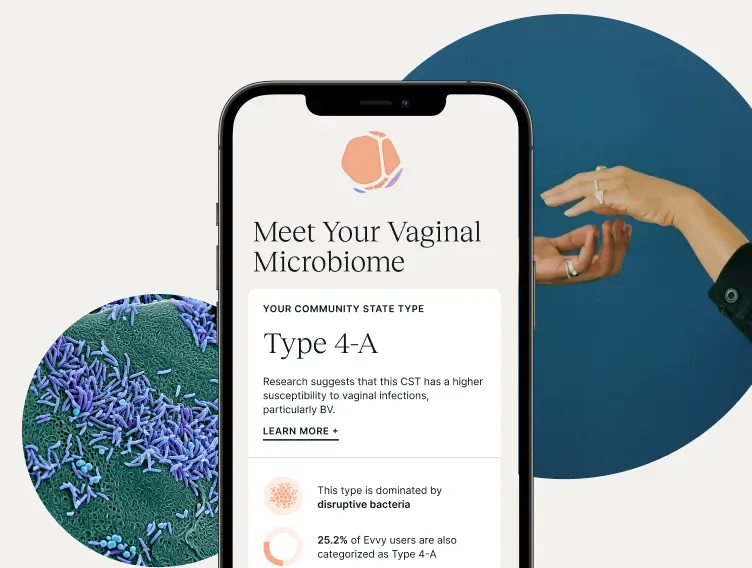
Recurrent symptoms? Get Evvy's at-home vaginal microbiome test, designed by leading OB-GYNs.
Inositol is a naturally occurring, vitamin-like compound. It’s sometimes called vitamin B8, though it's technically a sugar alcohol made naturally by your body. It's found in foods like fruit, beans, grains, and nuts, and it plays a role in cell structure and in how your body responds to insulin.
There are nine different forms of inositol, but as a supplement, it’s typically sold as one of two forms, or a blend of both:
An inositol supplement usually delivers a concentrated dose of one or both forms (well beyond what you'd get from food alone) in powder, capsule, or gummy form.
Insulin resistance is often at the center of most PMOS symptoms, even in people who don’t have overweight or obesity. When your cells stop responding well to insulin, your body compensates by producing more of it. Excess insulin tells your ovaries to produce more androgens, which can disrupt ovulation and drive PMOS symptoms like irregular periods, acne, and excess hair growth.
Myo-inositol seems to improve how your cells respond to insulin, which can help lower the excess insulin that's fueling unwanted androgen production. D-chiro-inositol works a bit differently, helping regulate how our body metabolizes (uses) glucose and makes androgens. Used together, research suggests they may support more regular ovulation, improved insulin sensitivity, and modest improvements in metabolic markers like cholesterol and triglycerides (the most common type of fat in your body).
Your ovarian tissue naturally maintains myo-inositol and D-chiro-inositol in roughly a 40:1 ratio, and that ratio has become the most extensively studied formulation in PMOS research. Most clinical trials showing benefit use something close to it.
This matters because more DCI isn't necessarily better. Some researchers have raised the possibility that too much D-chiro-inositol relative to myo-inositol could actually work against egg quality, since the two forms serve different roles in the ovary. It's a reason to be wary of supplements that load up on DCI without much science behind the ratio, rather than sticking close to what's actually been studied.
The evidence is genuinely decent, which isn't something you can say about most PMOS supplements. A 2023 systematic review and meta-analysis of randomized controlled trials found that inositol supplementation was associated with improvements in cycle length, testosterone levels, insulin markers, and body mass index (BMI) compared with placebo, with a safety profile similar to metformin — another common treatment option for PMOS — but fewer gastrointestinal (GI) side effects for most people.
That said, reviewers have consistently called for more high-quality, long-term trials to pin down exactly who benefits most and by how much. Inositol seems to help with the insulin resistance and hormonal piece of PMOS for many people, but it's not going to resolve every symptom, and results vary based on your specific hormonal profile, weight, and how consistently you take it.
Part of why the evidence isn't more clear-cut also comes down to PMOS itself. Despite affecting roughly one in eight women, it's still poorly understood and can vary greatly among individuals. Two people can have the same diagnosis with very different underlying drivers. Not everyone with PMOS has insulin resistance, for example, and it's not clear whether inositol offers much benefit to the subset of people whose PMOS isn't rooted in insulin issues to begin with.
Concentrations in clinical trials range from 1.1g to 4 g of myo-inositol per day, often split into two 2 g doses, sometimes paired with a small amount of D-chiro-inositol to approximate the 40:1 ratio (roughly 100 mg), and occasionally combined with folic acid.
This reflects what's been studied in research settings, not personalized medical advice. The right dose for you depends on your symptoms, other medications, and whether you're trying to conceive. Talk to your provider before starting, especially if you're on metformin or another insulin-sensitizing medication, since combining them isn't well studied.
Most trial protocols split the daily dose into two servings (one in the morning and one in the evening), often taken with food to reduce the mild GI upset some people notice at higher doses. Like with any supplement, consistency matters more than precise timing. Inositol works gradually, and most studies measure results after 12 weeks or longer of daily use, not days or a couple of weeks.
If remembering two separate doses is a barrier to sticking with it, that's worth factoring into your product choice, because a format you'll actually take consistently outperforms a "better" one you keep forgetting.
Inositol is generally well tolerated at the recommended dose. The most common (and temporary) side effects are mild nausea, bloating, or diarrhea. It's generally considered safe during preconception and pregnancy, but as with any supplement, check with your provider first, particularly if you're managing diabetes, are on other medications, or are pregnant or breastfeeding.
Not all inositol supplements are created equal. A few things worth checking on the label:
Luminary Vitamins' Balance gummies use this 40:1 ratio in a pill-free daily format, which is worth knowing about if capsule fatigue is the thing standing between you and consistency.
This article was created in partnership with Luminary Vitamins, whose Balance gummies deliver a clinically studied 40:1 ratio of myo-inositol to D-chiro-inositol in a daily, pill-free format. Explore Luminary's Balance gummies.