CONGRATS! YOU EARNED FREE SHIPPING.

Product Title
1
$0
$0
Subscription Title

Looking kind of empty in here.
We recommend:
Get advanced insights into symptoms, fertility, and other health outcomes. Prelim results in 1-3 days.

Tired of UTIs that won't clear? PCR urine testing detects more organisms faster. Here's how it works, what it finds, and how it compares to a standard culture.
Words by Olivia Cassano
Scientifically edited by Dr. Krystal Thomas-White, PhD
Medically reviewed by Dr. Kate McLean MD, MPH, FACOG
If you've been dealing with a urinary tract infection (UTI) that won't quit or keep getting infections that never seem to fully clear, you may have heard about PCR urine testing as an alternative to the usual culture.
PCR can detect more organisms faster, and in some cases, can even flag antibiotic resistance before you've started the wrong treatment. That said, it's not magic. A positive result still needs to be weighed against your actual symptoms, and, like any test, it can yield findings that require careful interpretation.
A standard urine culture takes 24–48 hours just to grow bacteria, and antibiotic sensitivity results can take even longer. PCR can be significantly faster, depending on the lab, sometimes within the same day. That speed can matter a lot when you're miserable and waiting for answers.
Learn more about how PCR urine testing works, how it compares to a dipstick urinalysis and traditional culture methods, how to collect a sample properly, and how Evvy's UTI+ Test fits into the picture.
So, what exactly is a PCR urine test, and why does it work differently from other diagnostic tests you've probably had before?
PCR stands for polymerase chain reaction. It's a lab technique that detects genetic material (DNA or RNA) directly from a sample (in this case, your urine). Originally developed for research, PCR is now used across medicine to diagnose everything from sexually transmitted infections (STIs) to COVID-19. For urinary tract infections (UTIs), it works by identifying the unique genetic fingerprint of bacteria or other pathogens in your urine, without needing them to grow first.
To understand why that matters, it helps to know how the other diagnostic tests work and where they fall short.
PCR is fundamentally different from the other two. A dipstick tells you something might be wrong. A culture grows whatever is present and identifies it over several days, but only if the bacteria cooperate. PCR skips the growing step entirely and looks directly for the organism's genetic fingerprint. That's why it can catch infections that standard culture misses, and why it's becoming an increasingly important tool for people dealing with recurrent or hard-to-treat urinary tract infections.
Recurrent symptoms? Get Evvy's at-home vaginal microbiome test, designed by leading OB-GYNs.
PCR detects DNA, which is the genetic building block of bacteria, fungi, and other pathogens. Because it's targeting genetic material rather than waiting for organisms to multiply, it's highly sensitive and works even when bacteria are present in small amounts that wouldn't show up on a culture.
That sensitivity is the main reason PCR can catch infections that standard culture misses, and it's also why results need to be read alongside your symptoms. Detecting DNA doesn't always mean you have an active infection, though.
PCR testing is especially useful when:
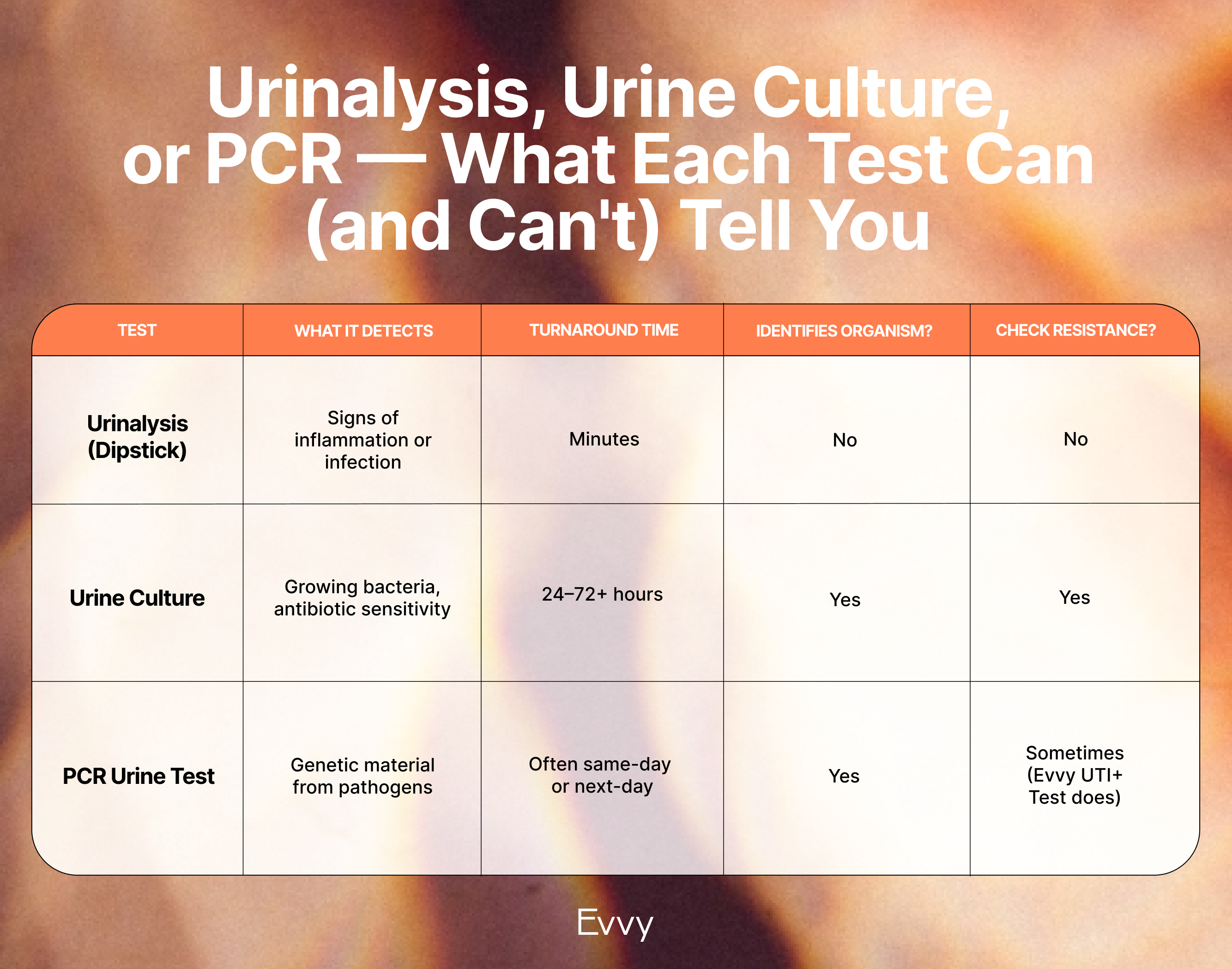
The right test depends on the situation. A dipstick is fine for a straightforward first UTI with classic symptoms. Urine culture is the traditional gold standard, especially when resistance patterns matter. PCR makes more sense when you need faster results, have had treatment failures, or want broader coverage in one test.
Urinalysis results are almost instant, which is why dipstick tests are often done in the doctor’s office as a first step. Standard urine cultures take 24–48 hours to grow bacteria, with sensitivity results following after that. PCR results vary by lab, but are often available same-day or within 24 hours, making it one of the faster options for getting organism-specific answers.
PCR testing is highly sensitive, but "highly sensitive" isn't the same as "always right." Here's what to know.
Some bacteria are slow-growing or fastidious, meaning they need very specific conditions to grow in a lab. Standard culture conditions aren't optimized for every organism, so some infections go undetected even when the pathogen is genuinely there. Current tests miss a large number of infections, and traditional culture methods can fail to detect up to 50–70% of pathogens.
PCR doesn't have this problem because it's looking for DNA, not waiting for growth. This makes it particularly useful for detecting less common organisms that are often missed by conventional methods. Urine PCR testing has demonstrated consistency with urine culture and is non-inferior to urine culture for detecting a UTI.
PCR urine testing is also especially useful in diagnosing recurrent or chronic urinary tract infections.
Because PCR testing is so sensitive, it can detect DNA from bacteria present in very small amounts, even if they’re not causing any symptoms. It can also detect genetic material from organisms that are dead or no longer active. This means a positive result doesn't automatically mean you have an infection that needs antibiotics. This is why your symptoms, medical history, and clinical context still matter. Remember: a positive PCR result is a data point, not a prescription. For this reason, your UTI+ Test result shows low/medium/high levels for each pathogen, and Evvy’s clinical team considers pathogen load along with your symptoms before diagnosing a UTI.
The price of PCR testing is currently higher than traditional urine culture, but costs are expected to decrease over time as the technology becomes more widespread. Costs vary depending on the lab, your insurance, and how many organisms the panel screens for. Another thing to consider is that access to PCR testing is currently limited — Medicare and Medicaid cover some urine PCR testing, but there's a good chance you'll have to pay out of pocket.
Evvy's UTI+ Test is designed to give you the organism identification and resistance gene insights of PCR without the typical cost barrier, making it a practical option if you're looking for faster, more detailed answers than a culture can offer. And if you have an FSA or HSA, the UTI+ Test is eligible for reimbursement through both. You'll pay upfront at checkout, but can claim the cost back — or pay directly with your FSA/HSA card at checkout via TrueMed — making it easier to access more detailed testing without it coming entirely out of your own pocket.
How you collect your sample matters more than most people realize. A contaminated sample can lead to an invalid or misleading result, so it's worth doing this carefully.
Clean-catch collection means collecting urine midstream (after the first few seconds of flow) using a sterile container, which helps prevent skin bacteria from contaminating your sample.
The "midstream" part is the most important. The first few seconds of urine can flush out bacteria from the skin around the urethra, which can contaminate your sample and make the results less reliable. If you happen to be on your period when collecting, do your best to avoid menstrual blood contaminating your urine sample.
To get the most accurate results from your PCR test, it’s important to follow a few simple steps after collecting your urine sample.
If you're tired of the cycle — symptoms, false negatives, antibiotics, more symptoms — Evvy's UTI+ Test offers a clearer solution.
Rather than waiting days for a culture, Evvy uses PCR-based technology to identify pathogens behind your infection and screen for antibiotic resistance genes. That means faster answers and, more importantly, more useful ones. You're not just finding out if something is wrong, you're finding out what, and what's most likely to treat it effectively.
And because urinary tract infections don't exactly give you time to wait around, your results are designed to be clear and actionable from the start. If you're eligible, you can order care directly through Evvy — and get precision prescription treatment reviewed by an Evvy-affiliated provider, same day, tailored to your specific results.
Evvy's UTI+ Test is designed for people with recurrent UTIs, persistent symptoms, or anyone who's been told "your labs are normal” even though something’s clearly wrong. It's an at-home test, meaning no waiting room, no prescription needed to get started, and results that come with clear, plain-language explanations.
A urine PCR test is used to detect infections in the urinary tract by looking for the genetic material of bacteria or other pathogens in a urine sample. It's often used when standard testing hasn't provided clear answers, or when faster results are needed.
PCR testing is highly sensitive, meaning it’s really good at detecting organisms, even when they're present in very small amounts. It's generally more sensitive than standard culture for certain organisms. That said, sensitivity can also mean detecting organisms that aren't actively causing infection, which is why results are best interpreted alongside symptoms and clinical context.
The turnaround time for PCR testing is faster than traditional urine culture, but it still requires transport time to the laboratory. PCR results are typically available the same day or within 24 hours, depending on the lab. Standard urine cultures take 24–48 hours just to grow bacteria, with antibiotic sensitivity results often following after that.
A positive PCR result means the test detected genetic material from a specific organism in your urine. It doesn't automatically mean you have an active infection that needs antibiotics, though. Your provider will weigh that result against your symptoms and overall health picture. Context matters.
Use a clean-catch midstream technique: clean the area first, start peeing into the toilet, then collect mid-flow in a sterile container. Deliver or ship the sample within 24 hours (or follow the instructions included in your at-home kit).
PCR and culture measure different things, but data show they're pretty much on par. PCR testing is generally more sensitive and faster and can detect organisms that culture may miss. Culture has the advantage of directly measuring how bacteria respond to specific antibiotics (something called phenotypic resistance testing). Both have a role; the best choice just depends on your situation. The main downside is that urine cultures can result in a high number of false negatives, particularly for slow-growing organisms and polymicrobial infections.
There's no single "most reliable" test that works for every situation. For a first, uncomplicated urinary tract infection, a dipstick plus culture is the go-to route. For recurrent or treatment-resistant infections, PCR testing offers broader detection and faster results. Evvy's UTI+ Test combines PCR-based detection with resistance gene screening, making it a strong option for people who need more than a basic culture can offer.