CONGRATS! YOU EARNED FREE SHIPPING.

Product Title
1
$0
$0
Subscription Title

Looking kind of empty in here.
We recommend:

Get advanced insights into symptoms, fertility, and other health outcomes. Prelim results in 1-3 days.

Learn the key differences between a UTI and a kidney infection, symptoms, diagnosis, treatment, and when to seek emergency care.
Words by Olivia Cassano
Scientifically edited by Dr. Krystal Thomas-White, PhD
Medically reviewed by Dr. Kate McLean MD, MPH, FACOG
A urinary tract infection (UTI) is, as the name suggests, a bacterial infection that can occur anywhere in the urinary tract. When most people talk about a UTI, they're usually referring to a bladder infection (known as cystitis), but without prompt treatment, that infection can travel upward and become a kidney infection (known as pyelonephritis).
The main difference is that kidney infections are significantly more serious than lower urinary tract infections. They often require longer antibiotic treatment and, in severe cases, hospitalization. Knowing the difference matters because the urgency and approach to treatment differ.
Keep reading to learn more about the difference between a UTI and a kidney infection. If you're experiencing symptoms and want answers fast, Evvy's UTI+ Test can help you get to the bottom of it and get the right treatment sooner.

Recurrent symptoms? Get Evvy's at-home vaginal microbiome test, designed by leading OB-GYNs.
The main difference between a UTI and a kidney infection is where the infection occurs in the urinary tract. The urinary tract includes the:
Most urinary tract infections start in the urethra or bladder, where bacteria (most commonly E. coli from the gut) enter and multiply. This type of lower urinary tract infection is the most common, and for many people, it stays localized there.
The problem is that bacteria don't always stay put. If a bladder infection goes untreated or undertreated (either because you stopped treatment early or because the bacteria were resistant to antibiotics), the bacteria can travel up the ureters and cause a kidney infection. This makes a kidney infection an upper urinary tract infection, and a more significant infection at that.
The key difference lies in location and severity. A bladder infection is uncomfortable, but it's generally straightforward to treat. A kidney infection involves a vital organ and carries a much higher risk of serious complications, including permanent kidney damage and sepsis. That's why recognizing which one you're dealing with (and acting quickly) is so important.
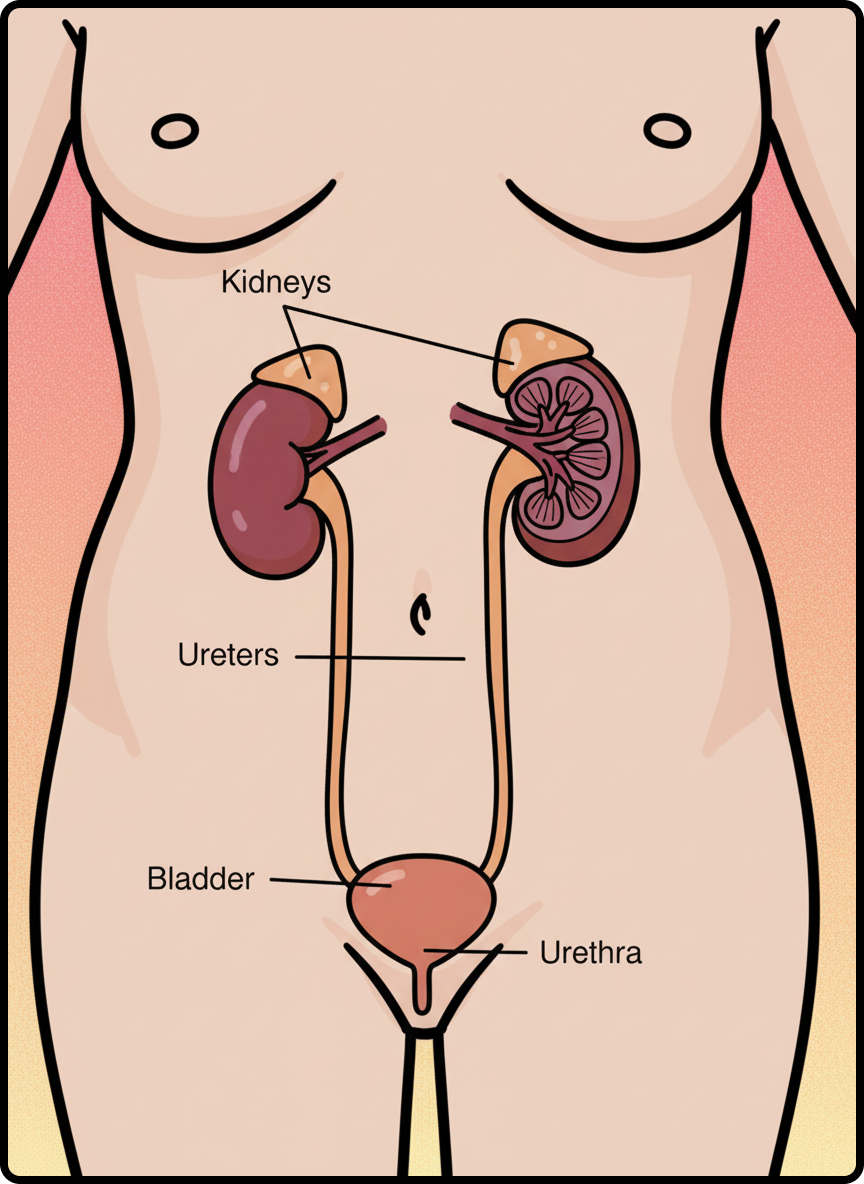
Kidney and bladder infections share many symptoms, which can make it tricky to tell them apart at first.
Both cause the hallmark signs of a urinary tract infection, like burning when you pee, urgency, frequency, and changes in your urine. But a kidney infection also brings a distinct set of symptoms that signal the infection has moved beyond the bladder.
Understanding where symptoms overlap and diverge is key to knowing how serious your infection might be and how quickly you need to seek care.
Given that bladder and kidney infections are both considered urinary tract infections, they share many symptoms. Bladder and kidney infection symptoms include:
Kidney infections cause all the usual symptoms of a UTI, along with:
If you experience any of these symptoms, it’s a pretty reliable sign that the infection has moved beyond the bladder and spread to the kidneys.
If your usual UTI symptoms — burning, urge to urinate, and frequent urination — aren't improving after a day or two, or are getting worse, that's a sign something more serious may be going on.
The clearest giveaway that an infection has spread to the kidneys is the onset of new symptoms on top of your usual UTI discomfort: fever and chills, pain in your back or sides, nausea, or a general sense of feeling unwell. These systemic symptoms indicate that the infection has spread beyond the bladder and requires immediate attention.
At this point, prompt testing and treatment are critical. A kidney infection won't clear on its own, and the longer it goes untreated, the higher the risk of complications like kidney damage or sepsis. If you notice any of these warning signs, don't wait; see a doctor as soon as possible.
Yes, most UTIs start as lower urinary tract infections that were either untreated or under-treated and then spread upward. Most UTIs begin in the urethra or bladder, but bacteria can travel up the ureters to reach the kidneys. This progression can happen within days, so it’s really important not to ignore any symptoms and get prompt treatment.
Not every untreated UTI will advance to a kidney infection, but the risk is real, and certain factors make it more likely:
If you have urinary symptoms that aren't improving or that worsen after a day or two, see a doctor as soon as possible.
Both infections are typically diagnosed with a urinalysis (checking for white blood cells, bacteria, and nitrites in urine) and a urine culture (identifying the specific bacteria and which antibiotics will work against them).
To diagnose a kidney infection, your doctor may also order imaging tests, such as an ultrasound or CT scan, especially if symptoms are severe, to check for complications, such as an abscess or a blockage.
Bladder infections are typically treated with a short course of oral antibiotics for usually three to seven days, depending on the antibiotic prescribed and your medical history. Common options include nitrofurantoin, trimethoprim-sulfamethoxazole, and fosfomycin, and symptoms often improve within a day or two of starting treatment.
Kidney infections, on the other hand, require a longer antibiotic course, typically 7 to 14 days. Mild to moderate cases can be managed with oral antibiotics at home, but severe kidney infections may require hospitalization for intravenous (IV) antibiotics. This allows for closer monitoring and ensures the medication is absorbed effectively when a patient can't keep oral medication down.
Unlike mild bladder UTIs, which sometimes resolve on their own, kidney infections can’t be safely cleared without antibiotics. Left untreated, they can cause kidney damage or progress to sepsis, a life-threatening response to infection.
If you suspect you have a UTI, don't wait it out. You can take Evvy’s UTI+ Test, which detects 12 uropathogens (including ones missed by standard culture tests) plus antibiotic resistance. You’ll receive results in just one business day after your sample reaches our lab, and, if eligible, an Evvy-affiliated provider will prescribe targeted medication for your UTI.
Most UTIs can be managed with a doctor's visit and a course of antibiotics, but some symptoms warrant emergency care. Go to the ER if you experience:
If you're unsure whether your symptoms are serious, err on the side of caution and seek care.
The key is to pay attention to where your symptoms show up. A UTI typically causes hallmark symptoms such as a burning sensation when you pee, urgency, increased frequency, and cloudy or foul-smelling urine. Common symptoms of a kidney infection include severe back or flank pain, persistent vomiting, and blood in the urine. If you're feeling unwell beyond just the usual UTI discomfort, that's a sign the infection may have spread, and a reason to see your healthcare provider right away.
There's no fixed timeline, but the progression can happen within just a few days. That's why it's so important not to wait out your symptoms. If your UTI symptoms aren't improving after a day or two, or if they're getting worse, see a doctor rather than hoping they'll resolve on their own.
The five main warning signs to watch for are: fever and chills, back or flank pain, nausea or vomiting, a general feeling of being unwell or fatigued, and the usual UTI symptoms like burning when you pee and frequent urges to go. If you're experiencing any combination of these, especially the first three, you should seek medical care as soon as possible.
Staying hydrated is always a good idea when you have a UTI, as it helps flush bacteria from the bladder and keep things moving. But drinking water alone won't flush out a kidney infection. Unlike some mild UTIs, kidney infections require antibiotics to clear. Think of hydration as supportive care, not a treatment. If you suspect a kidney infection, you should see a doctor rather than trying to manage it on your own.
No, a kidney infection won’t clear up on its own, and it's important not to wait and see. Unlike some mild bladder UTIs that occasionally resolve without treatment, kidney infections always require antibiotics. Without treatment, the infection can cause kidney damage or progress to sepsis, a life-threatening condition. If you have any symptoms of a kidney infection, like fever, flank pain, or nausea alongside your usual UTI symptoms, get medical attention as soon as possible rather than hoping it passes.
The biggest clues are the symptoms that go beyond the bladder. A standard UTI causes burning, urgency, and cloudy urine — it’s uncomfortable, but usually localized. A kidney infection causes systemic, more severe symptoms such as fever, chills, back or flank pain, and nausea, which indicate the infection has spread. If you're unsure, the best approach is to get tested. Evvy’s UTI+ Test can confirm a urinary tract infection, and your doctor may order imaging if a kidney infection is suspected.
Both infections are typically diagnosed with a urinalysis, which checks for white blood cells, bacteria, and nitrites in your urine, and a urine culture, which identifies the specific bacteria and which antibiotics will work against them. For a kidney infection, your doctor may also order an ultrasound or CT scan to check for complications like an abscess or blockage. Blood tests may also be used to assess how the infection is affecting the rest of your body.