CONGRATS! YOU EARNED FREE SHIPPING.

Product Title
1
$0
$0
Subscription Title

Looking kind of empty in here.
We recommend:
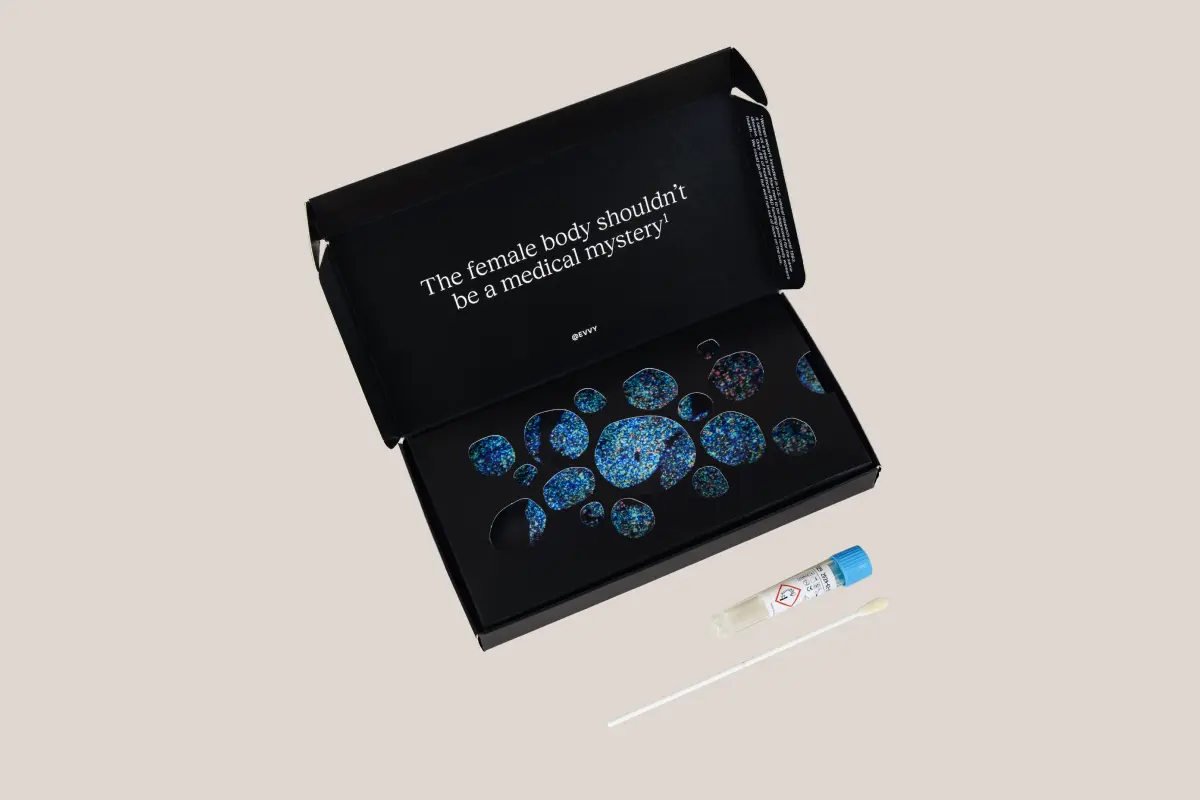
Get advanced insights into symptoms, fertility, and other health outcomes. Prelim results in 1-3 days.

Comparing Evvy's UTI+ Test with Acon Labs' HealthyMe UTI strips? Here's how each works, what they detect, and which one makes sense for your symptoms.
Words by Olivia Cassano
Scientifically edited by Dr. Krystal Thomas-White, PhD
Medically reviewed by Dr. Kate McLean MD, MPH, FACOG
Whether you're dealing with a first-time urinary tract infection (UTI) or you've been down this road more times than you can count, it makes sense that you'd want answers without having to wait for a doctor’s appointment.
Both Evvy and Acon Labs let you test for a UTI at home using a urine sample, but how they work (and what they actually tell you) differs a lot.
Acon Labs makes the HealthyMe UTI Test Strips, a dipstick-style test that checks your urine for indirect markers of infection (specifically leukocytes and nitrites). Evvy's UTI+ Test is a lab-based PCR test that identifies specific UTI-causing bacteria and fungi, as well as antibiotic resistance genes, to give you the full picture of what's going on.
Below, we break down exactly how each test works, what it detects, how quickly you get results, and, most importantly, which option makes sense for your situation.
At a glance, these two at-home tests sit at opposite ends of the spectrum. One is a fast, inexpensive screening tool that gives you results in a couple of minutes. The other is a diagnostic test processed in a lab, designed to give you and your provider enough information to make targeted treatment decisions. Here's how they compare across the factors that matter most:
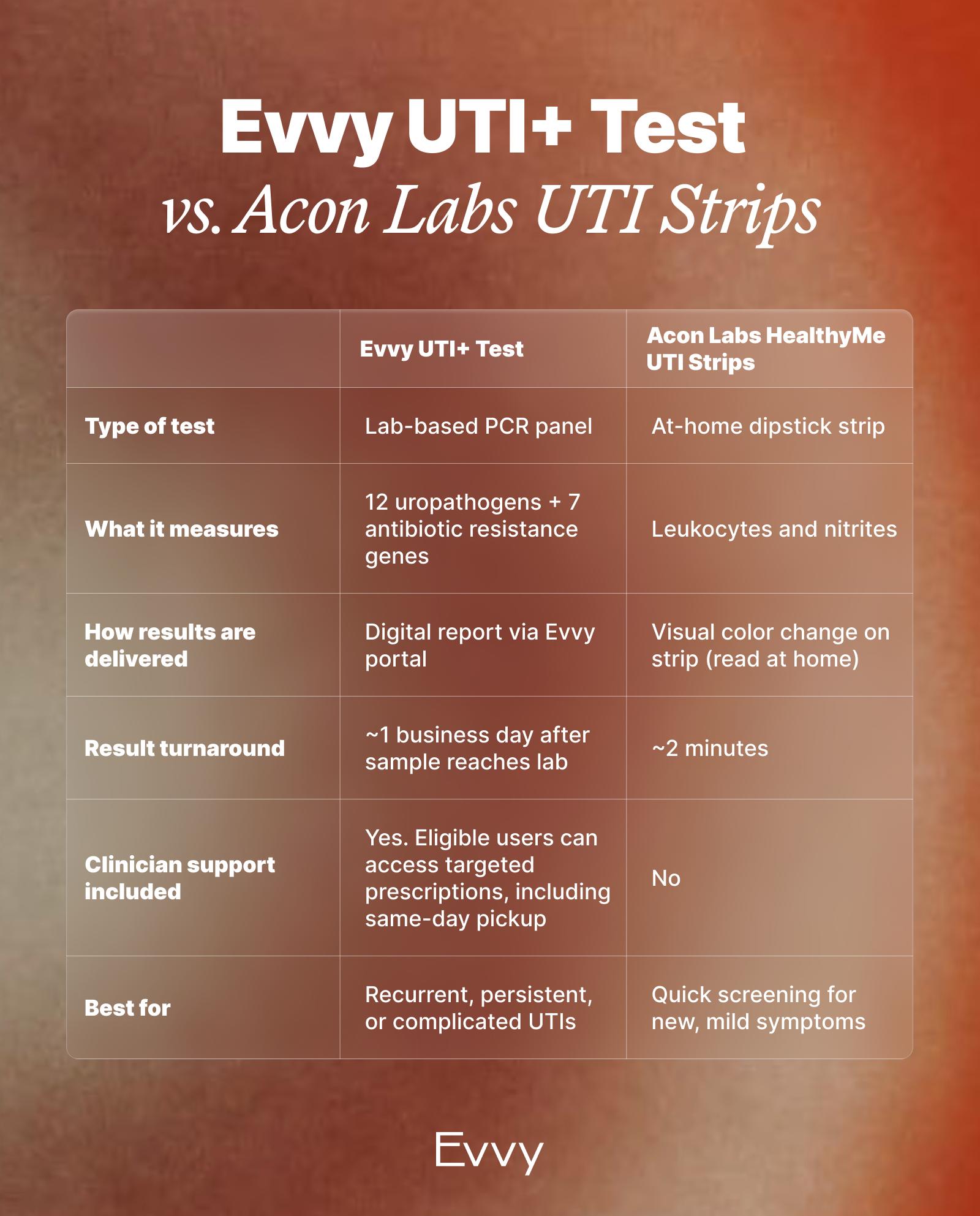
The testing experience is very different with each product, not just in terms of technology, but in what you're actually doing at home and what happens after.
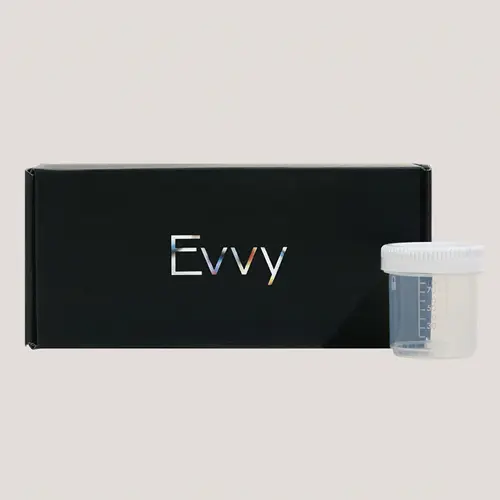
With Evvy, you collect a urine sample at home using the kit Evvy mails to you. You send the sample back to Evvy's partner lab, where it's processed using quantitative polymerase chain reaction (qPCR), a technology that detects the DNA of specific microorganisms directly from your sample.
PCR doesn't require bacteria to be actively growing in a culture to detect them. It searches for genetic material from 12 key UTI-causing bacteria and fungi, and simultaneously screens for seven antibiotic resistance genes. Results arrive in around 1 business day after your sample reaches the lab — that's up to three days faster than a traditional urine culture.
You receive an easy-to-read digital report that shows which pathogens were detected and flags any resistance genes present. If you're eligible, an Evvy-affiliated provider can prescribe targeted treatment based on your results, with the option for same-day pharmacy pickup.
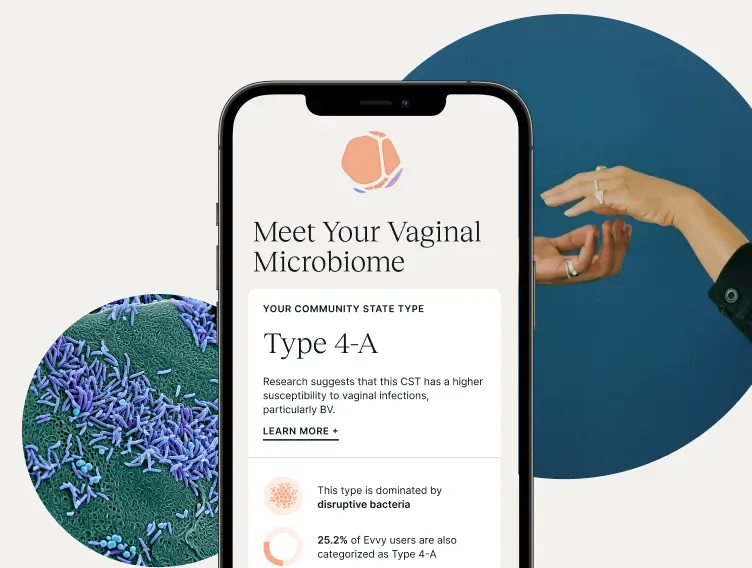
If you want to go a step further, the Vaginal Health & UTI+ Test bundles Evvy's UTI urine test with an at-home vaginal microbiome test — and if UTIs are a recurring thing for you, it's worth knowing why the two are connected. Research shows that your vaginal and urinary health are closely linked. When Lactobacillus levels in the vaginal microbiome drop, the risk of recurrent UTIs goes up. This makes sense anatomically, since the urethra and vaginal opening are very close together, making it easy for bacteria to travel between them. Testing both at once gives you and your provider a much fuller picture of what might be driving repeat infections, rather than treating each UTI in isolation. It can also help rule out vaginal infections that often get mistaken for UTIs, like yeast infections and bacterial vaginosis (BV) — so you're not treating the wrong thing.
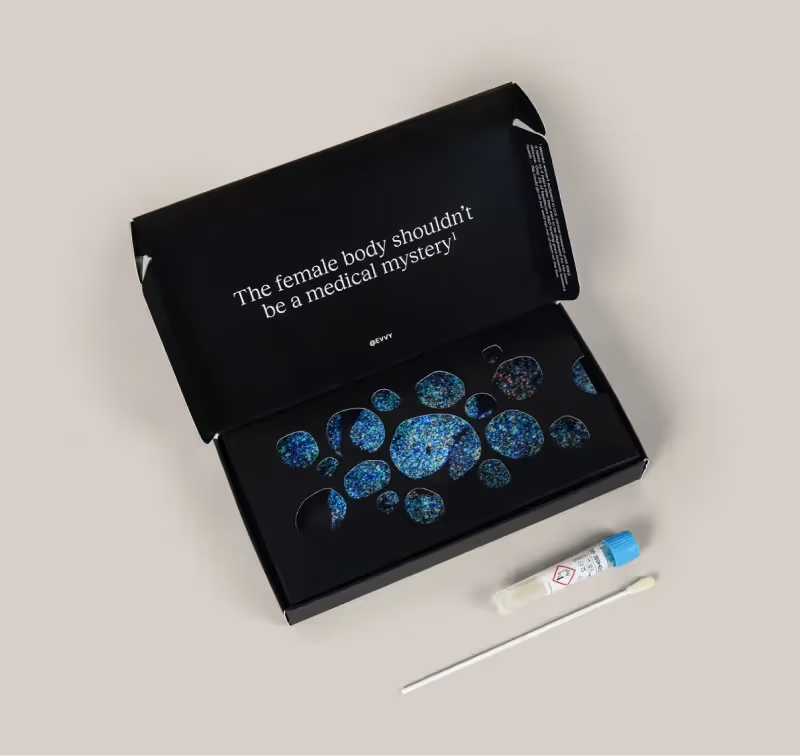
Recurrent symptoms? Get Evvy's at-home vaginal microbiome test, designed by leading OB-GYNs.
Acon Labs' HealthyMe UTI Test Strips are a dipstick-style test you use entirely at home. You briefly dip the strip into a fresh urine sample, then hold it flat and wait for about 2 minutes while the reactive pads change color.
The strips check for leukocytes (white blood cells, which signal that your immune system is reacting to something) and nitrites (a byproduct produced by certain bacteria). You compare the color changes against a reference chart included in the packaging to read your result (positive, negative, or inconclusive).
The strips are FDA-approved for over-the-counter use and are widely available online and in pharmacies. At around $10 for a pack of three, they're one of the most accessible and affordable options on the market. They're easy to use, require no sample shipping, and give you an immediate read on whether something might be going on, though they can't tell you what that something is.
Understanding what each test is actually measuring helps explain why the results feel so different and why one may leave you with more questions than answers.
Evvy's PCR panel looks directly for the genetic material of 12 specific microorganisms known to cause UTIs, including bacteria and fungi. Because it's working at the DNA level, it can detect pathogens even at low concentrations, including organisms that a standard urine culture might miss.
In addition to pathogen detection, Evvy screens for seven antibiotic resistance genes. Identifying resistance markers means your provider can understand early on which antibiotic classes are less likely to work, which is especially useful if you've had infections that didn't clear with first-line treatment. This level of detail is especially valuable for people dealing with persistent or recurrent UTIs, for whom the standard approach of prescribing broad-spectrum antibiotics and hoping for the best hasn't worked.
The HealthyMe strips screen for two indirect markers: leukocytes and nitrites. Both can suggest that a UTI might be present, but neither confirms it nor tells you what's causing the infection.
Nitrites are produced when certain bacteria convert nitrates in your urine, so a positive nitrite result is a signal that bacteria may be present. Leukocytes (white blood cells) indicate that your immune system is responding to something, but that something could be a UTI or a range of other conditions.
Crucially, the strips don't identify which organism is involved, whether you have a mixed infection with multiple pathogens, or whether the bacteria involved are resistant to common antibiotics. Some bacteria that cause UTIs don't produce nitrites at all, which can lead to false-negative results even when an infection is present. If your symptoms persist or keep coming back, a strip result (positive or negative) won't give you the information you need to move forward.
Both tests are relatively straightforward to use, but "accuracy" means very different things depending on what you're trying to find out.
PCR-based testing is considered more sensitive than dipstick testing for identifying specific pathogens. Because it detects DNA rather than relying on indirect markers, it's less likely to miss low-level or hard-to-grow organisms. Standard urine cultures (the traditional diagnostic benchmark) can miss up to 50–70% of pathogens, and even then, results take 2 to 3 days. Evvy's PCR approach delivers results in around 1 business day after the sample arrives at the lab, with more comprehensive detection built in.
For those experiencing recurrent UTIs, unexplained symptoms, or infections that have not responded to initial antibiotic therapy, increased diagnostic specificity can provide a more accurate diagnosis and insight into why previous treatments may have failed.
Dipstick tests are a fast, low-cost screening option, and for a healthy adult experiencing their very first UTI with mild, classic symptoms, they can be a useful first step. When both leukocyte and nitrite markers come back positive, there's a reasonably high likelihood of infection.
Where strips are less reliable is in more complex situations, including infections caused by organisms that don't produce nitrites (meaning the strip reads negative even when bacteria are there), or when someone is immunocompromised and white blood cell activity is lower than expected. They're also not helpful in determining treatment. A positive strip tells you something is probably happening, but not what to do about it beyond seeking further testing or care.
These tests aren't really rivals; more so, they serve different needs at different stages of the process.
If you've had two or more UTIs in the past 6 months (or three or more in the past year), or if you've had infections that didn't resolve after a course of antibiotics, Evvy's UTI+ Test is the stronger choice. The same applies if your symptoms are unusual, if you've previously been told you have antibiotic-resistant bacteria, or if you've received conflicting results from previous tests.
In these situations, knowing which specific pathogen is present — and which resistance genes it carries — can change the course of your treatment. It gives you and your provider something concrete to work with, rather than repeating the cycle of empiric antibiotic prescriptions that may or may not be effective.
If you're dealing with your first-ever UTI and your symptoms are classic and mild, a dipstick test like the Acon Labs HealthyMe strips can serve as a quick initial check. They're widely available, inexpensive, and give you an immediate result.
But a positive strip result isn't a diagnosis, and it doesn't come with a treatment plan. UTIs require prescription antibiotics to clear properly, and over-the-counter options, like pain-relief products, can ease symptoms but won't treat the underlying infection. That means if your strip comes back positive, you'll still need to contact your provider to get the antibiotic prescription you actually need. Factor in waiting for an appointment and pharmacy turnaround, and that "two-minute result" can still mean days before you feel better.
Evvy's UTI+ Test skips that extra step. If you're eligible, an Evvy-affiliated clinician reviews your PCR results and can prescribe targeted antibiotics based on exactly what's causing your infection — with same-day pickup available at your local pharmacy. So not only do you get more accurate information, you can often have treatment in hand faster than the dipstick-plus-provider-visit route.
Reach out to a provider if:
Even if you use Evvy's UTI+ Test and receive a detailed report, an Evvy-affiliated provider will review your results alongside your symptoms to recommend appropriate treatment. If your situation is complex, they may refer you for additional in-person care. No test — however thorough — replaces a healthcare provider who knows your full health history.
The core difference is what each test actually detects. Acon Labs' HealthyMe strips are dipstick tests that detect indirect markers of infection and deliver a result in about 2 minutes at home. Evvy's UTI+ Test is a lab-based PCR test that identifies 12 specific UTI-causing organisms and seven antibiotic resistance genes from a urine sample you mail in. The Evvy test gives you a detailed breakdown of what's causing your symptoms and which treatments are most likely to work (something a dipstick simply can't do).
Evvy's UTI+ Test is the better fit for recurrent or complicated UTIs. If your infections keep coming back, are difficult to treat, or haven't responded to standard antibiotics, identifying the specific pathogen and any resistance genes present is essential to breaking the cycle. Dipstick tests like the Acon Labs strips can't provide that level of information.
Yes. If you're experiencing mild symptoms for the first time, a dipstick test can be a quick initial screen. But if symptoms persist, return shortly after treatment, or you receive a negative strip result that doesn't match how you feel, ordering an Evvy UTI+ Test gives you the deeper data needed to understand what's actually going on. It's also worth noting that a negative dipstick result doesn't always mean there's no infection.
It depends on your symptoms and situation. Evvy includes access to an affiliated clinician as part of the testing process, and eligible users can receive a targeted prescription based on their Evvy test results. A dipstick test, on the other hand, offers no guidance to clinicians. In either case, if symptoms are severe, involve fever or back pain, or don't resolve within a reasonable timeframe, in-person care is important.
For a healthy person experiencing their first mild UTI, starting with a low-cost dipstick is reasonable. But if you've dealt with recurrent infections, antibiotic treatment failures, or persistent symptoms, the cost of repeated ineffective treatment — in time, discomfort, and additional prescriptions — often exceeds the upfront cost of a comprehensive test. Evvy's UTI+ Test is designed to give you targeted answers the first time, so you're not spending weeks cycling through treatments that may not address the actual cause.