CONGRATS! YOU EARNED FREE SHIPPING.

Product Title
1
$0
$0
Subscription Title

Looking kind of empty in here.
We recommend:
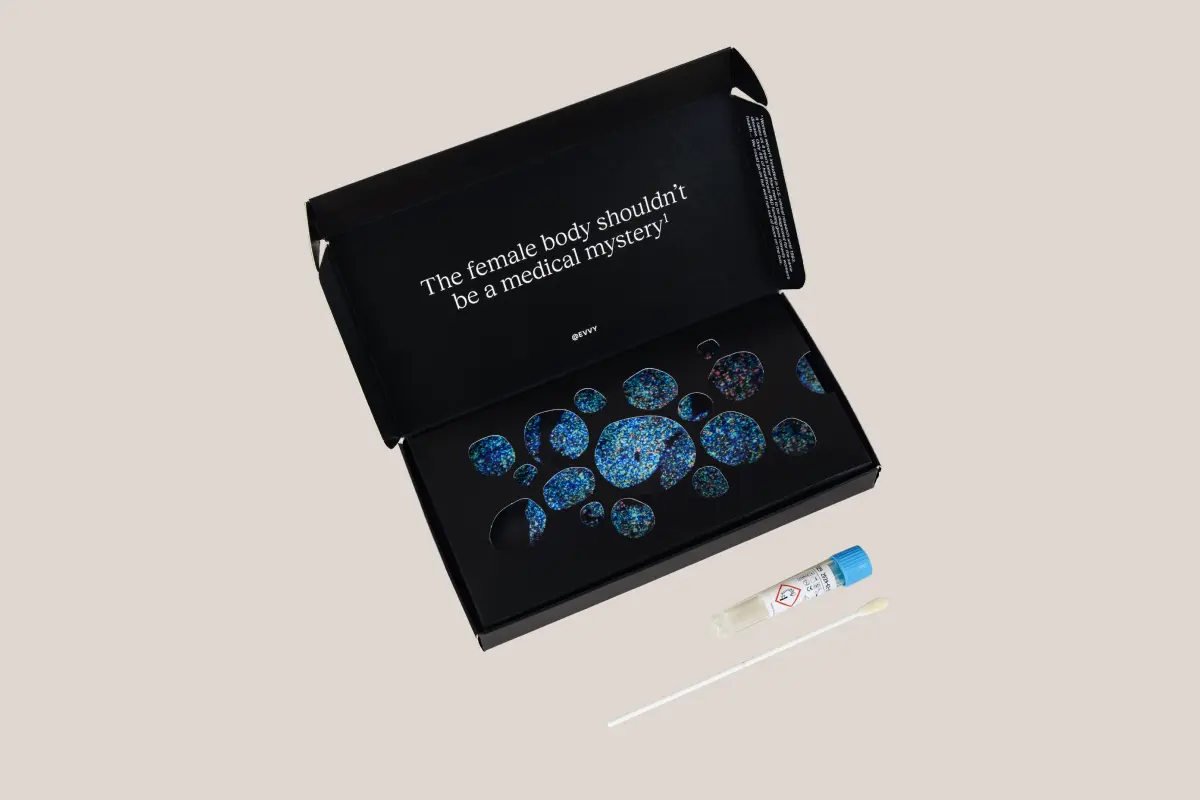
Get advanced insights into symptoms, fertility, and other health outcomes. Prelim results in 1-3 days.

AZO strips screen for UTI signs. Evvy's PCR test identifies the exact pathogen and resistance genes. Here's how they compare, and when each makes sense.
Words by Olivia Cassano
Scientifically edited by Dr. Krystal Thomas-White, PhD
Medically reviewed by Dr. Kate McLean MD, MPH, FACOG
When you can feel a urinary tract infection (UTI) coming on, taking AZO's home UTI test strips feels like the obvious first move. They're affordable and available in all major pharmacies. But 2 minutes later, you're staring at a result that raises more questions than it answers. Maybe the colors are ambiguous, or it reads negative, but your symptoms feel very, very real. Or maybe you test positive, and still have no idea what's causing the infection or which treatment will actually work.
The confusion usually comes down to what each test is actually doing. AZO UTI Test Strips are urine dipstick tests that check for indirect signs of infection, while Evvy's UTI+ Test is an at-home UTI test that uses PCR to identify specific organisms and antibiotic resistance genes behind your symptoms.
Below, we explain how each test works, which one detects UTIs earlier, and what the true cost per test is, so you can make the right call.
AZO's UTI test kit is a screening tool, not a diagnostic one. They don't identify bacteria directly; instead, they look for two chemical signals in your urine that tend to appear when the urinary tract is under stress from infection.
That makes strips genuinely useful as a first check. If you're unsure whether your symptoms are UTI-related or something else, a positive result on a strip is a useful indication that it's time to see a doctor. But strips have real blind spots, especially when symptoms are early, atypical, or part of a recurrent pattern.
AZO strips detect white blood cells (leukocytes) and nitrites.
A positive on one or both markers doesn't automatically confirm a UTI. It means the warning signs associated with infection are present, which is meaningful, but not the same as predicting urinary tract infections.
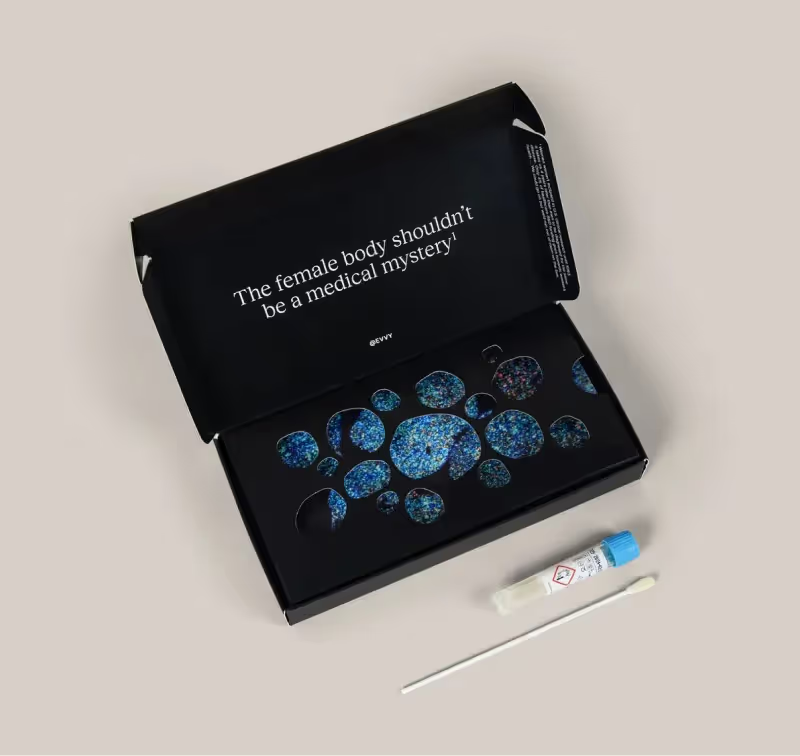
Recurrent symptoms? Get Evvy's at-home vaginal microbiome test, designed by leading OB-GYNs.
Real-world strip accuracy is more complicated than the box suggests. Common reasons results can mislead include:
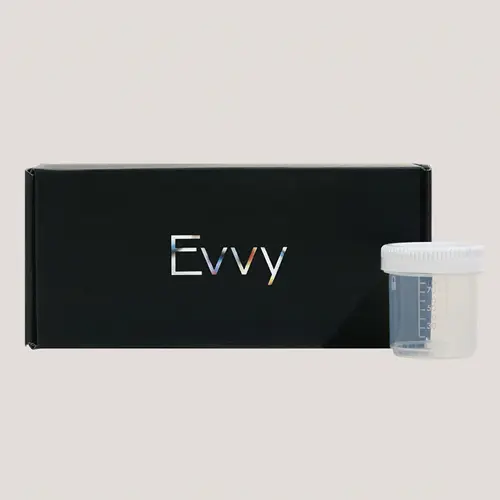
Where strips look for indirect chemical signals, polymerase chain reaction (PCR) testing takes a different approach entirely. Evvy's UTI+ Test uses PCR technology to detect the genetic material of specific organisms in your urine, so it looks for the actual pathogens, not just the body's response to them.
This changes the type of answers you get from your UTI test results. Instead of a positive or negative color-change result, you get a report identifying which organisms were detected and, crucially, which antibiotic resistance genes are present. That information is clinically interpreted by a provider who can prescribe the right treatment from the start.
Standard urine cultures (the lab test your doctor typically orders) can miss up to 70% of pathogens and take days to return results. Evvy's PCR test returns results within one business day of the urine sample arriving at the lab, and detects pathogens that cultures routinely miss.
“Early detection" means something different with each test, and each has a distinct timing advantage depending on your situation.
PCR technology doesn't depend on the same biological conditions that a dipstick does. It can detect pathogen DNA even when bacterial load is relatively low, when organisms don't produce nitrites, or when inflammatory markers haven't yet risen enough to trigger a leukocyte response.
That means Evvy may return a positive result in situations where a strip would read negative, particularly at the beginning of an infection, in cases of recurrence, when the organism is unusual, or when previous cultures have come back negative despite ongoing symptoms.
For people caught in a cycle of recurrent UTIs and inconclusive test results, PCR testing can change the picture. It can find what other tests are missing.
Strips are faster and require no lab. If you're symptomatic and want a same-day answer, a strip can give you a result in 2 minutes. They're most useful when:
They're least helpful when:
AZO UTI Test Strips are available over the counter at pharmacies and online. A three-count box typically retails for about $10.49, which puts the cost at roughly $3.50 per strip. There's no subscription model or lab analysis involved, so you get the result at home in 2 minutes and take it from there.
Evvy's UTI+ Test is priced at $248 per test as a one-time purchase, or $217.99 per test with a quarterly subscription. The price includes PCR lab analysis, results within 1 business day of lab arrival, and, for eligible users, the option to receive a targeted prescription the same day from an Evvy-affiliated provider. The Evvy UTI+ Test is eligible for FSA and HSA spending, so you can use pre-tax dollars to cover the cost.
When comparing these in terms of cost, it's worth considering what you're getting for the difference. An AZO strip tells you whether inflammatory markers are elevated. Evvy tells you what's causing the infection, whether your antibiotic options are limited by resistance, and — when paired with the Evvy Vaginal Health Test — whether your vaginal microbiome is contributing to repeat infections. The cost of a test that leads to the wrong treatment, or no treatment at all, adds up quickly: nearly one in two women is prescribed an antibiotic that doesn't work against their specific infection. When a UTI is missed or treated with the wrong antibiotic, the infection can turn into a much more serious kidney infection.
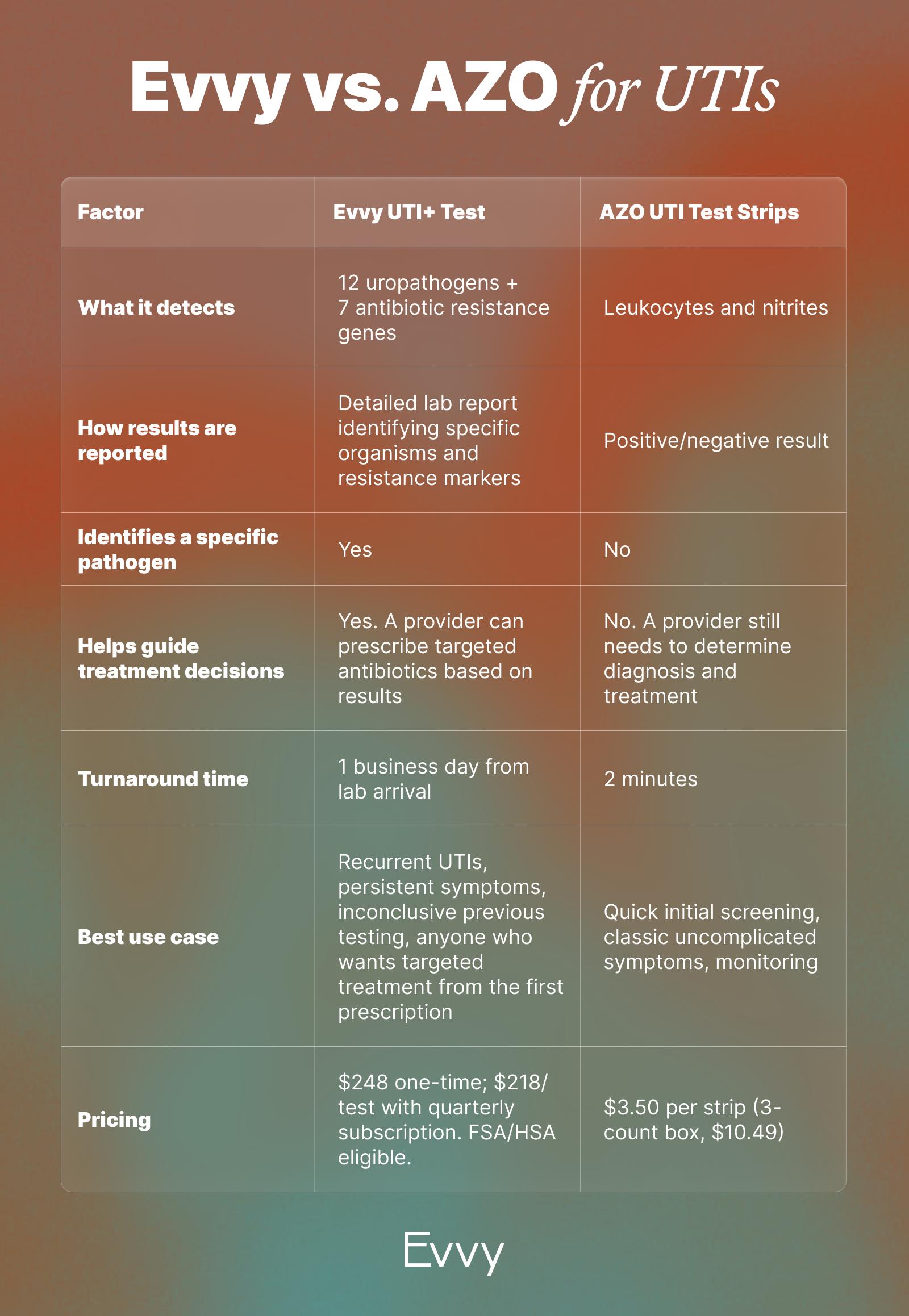
If you want a fast, low-cost signal that you may have an infection, an AZO strip gives you that. If you want to know what's causing it — and make sure the first treatment you take actually works — Evvy's UTI+ Test is in a different category.
Evvy's UTI+ Test isn't a test strip; it's a lab-based PCR urine test, which is a meaningfully different technology. AZO strips detect chemical markers associated with infection (leukocytes and nitrites), while Evvy detects the genetic material of 12 specific pathogens, as well as antibiotic resistance genes. AZO strips are a useful screening tool for quick, at-home results. Evvy is a comprehensive diagnostic test for people who need precise answers, especially those with recurrent UTIs, inconclusive previous results, or symptoms that haven't responded to standard treatment.
It depends on the context. AZO strips return results in 2 minutes, so you get a screening result faster. But PCR technology can detect pathogen DNA before inflammatory markers have risen enough to trigger a dipstick response, and it identifies organisms that strips routinely miss, including many that don't produce nitrites. For early or atypical infections, Evvy may detect what a strip misses entirely.
AZO test strips cost approximately $3.50 per strip. The Evvy UTI+ Test is $248 as a one-time test, or $217.99 per test with a quarterly subscription. The Evvy test includes full PCR lab analysis and results within one business day, with the option for eligible users to receive a same-day targeted prescription. The Evvy UTI+ Test is also eligible for FSA and HSA spending.
Yes. Evvy's UTI+ Test uses PCR technology, which is designed to detect pathogen DNA more sensitively than standard urine cultures. The test screens for 12 uropathogens and 7 antibiotic resistance genes, providing providers with the information they need to prescribe the right treatment the first time.
Evvy's approach to recurrent UTIs goes further than a standard test. When the UTI+ Test is paired with Evvy's Vaginal Health Test, you can see whether your vaginal microbiome is contributing to repeat infections, an often-overlooked piece of the picture. Evvy's own data found that 47% of users who reported a recent UTI had UTI-related bacteria present in their vaginal microbiome. Identifying that link is the first step toward addressing the cause, rather than just treating each infection as it arrives.