CONGRATS! YOU EARNED FREE SHIPPING.

Product Title
1
$0
$0
Subscription Title

Looking kind of empty in here.
We recommend:
Get advanced insights into symptoms, fertility, and other health outcomes. Prelim results in 1-3 days.

Silicone or water-based lube — which is safer for your vaginal microbiome? We break down the differences, what ingredients to avoid, and what gynecologists recommend.
Words by Olivia Cassano
Scientifically edited by Dr. Krystal Thomas-White, PhD
Medically reviewed by Dr. Kate McLean MD, MPH, FACOG
Lubricant is one of those things that's easy to grab off a shelf without thinking too hard about it. If you care about your vaginal health, though, it's worth a closer look. Not all lubes are created equal, and the wrong formula can actually do more harm than good: disrupting your vaginal pH, damaging protective Lactobacillus bacteria, or irritating sensitive tissue.
The two most commonly recommended types are silicone-based and water-based lubricants, and while both have their place, they behave quite differently in the body. Keep reading to learn how each one works, when to use each, what ingredients to watch out for, and what the research actually says about their effects on vaginal health. And if you want a deeper picture of your vaginal microbiome, Evvy's Vaginal Microbiome Test can give you the clearest possible baseline to work from.
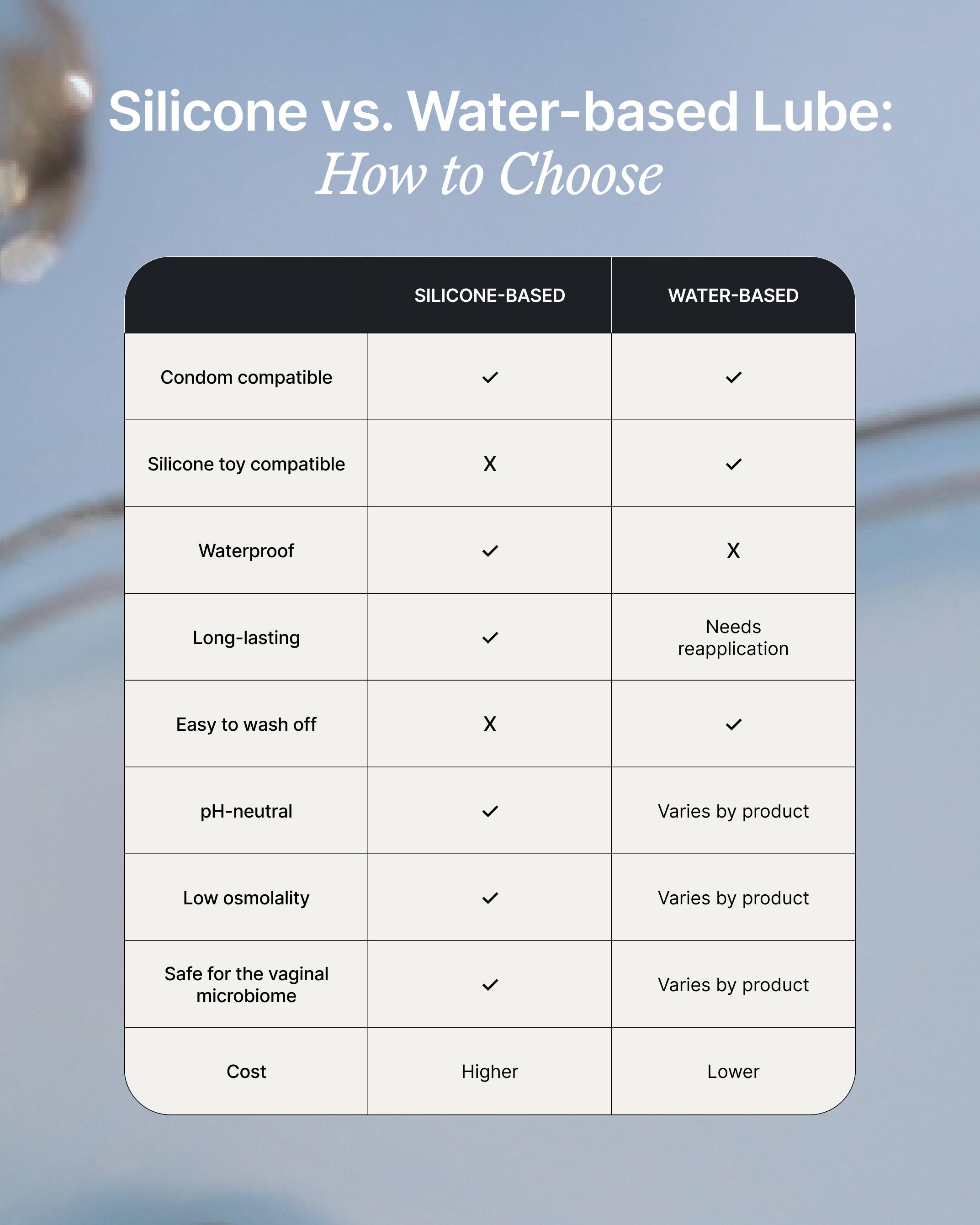
Silicone-based lubricants are made from synthetic silicone polymers (most commonly dimethicone, cyclomethicone, or dimethiconol). Unlike water-based formulas, they don't absorb into the skin, which means they sit on the surface and provide a long-lasting, slippery glide that doesn't evaporate or dry out mid-session. They're also waterproof, making them a popular choice for showers or baths.
From a vaginal health perspective, silicone lubricants have a genuinely strong safety profile. Because they don't contain water, they don't need preservatives, which is one of the main ways lubricants introduce potentially irritating ingredients.
Research confirms that silicone lubes are gentle on the cells lining the vaginal canal (called the epithelial cells), don't damage tissue, and don't appear to disrupt the vaginal microbiome with repeated use. They're also pH-neutral, meaning they won't shift the vagina's natural acidity, and because they're not water-based, they don't affect osmolality (essentially, the concentration of particles in the fluid around your vaginal cells). When a product has too high an osmolality, it draws water out of your vaginal cells, causing them to dry out and become more vulnerable to irritation and infection. Silicone sidesteps this issue entirely, which is one of its biggest advantages over many water-based formulas.
That said, silicone isn't universally compatible. It can’t be used with silicone sex toys, as it degrades the material over time. It's also notoriously difficult to wash off skin and sheets, and leaves a slicker residue than water-based options.
Silicone lubricants have a lot going for them from a vaginal health standpoint. They're long-lasting without needing reapplication, compatible with latex condoms, waterproof, and — crucially — don't disrupt vaginal pH, osmolality, or Lactobacillus populations. For people with sensitive vaginal tissue, recurring irritation, or dryness, this makes them a strong first-choice option.
The limitations are mostly practical. Silicone lubricant is incompatible with silicone toys, harder to wash out, and can feel heavier or more synthetic than water-based alternatives. It's also worth noting that items containing a plastic-silicone blend — such as some estradiol vaginal rings — are incompatible with silicone-based lubricants, so check with your provider if you're using hormonal devices. Cost is a consideration too: silicone formulas tend to run slightly more expensive, though a little goes a long way.
Recurrent symptoms? Get Evvy's at-home vaginal microbiome test, designed by leading OB-GYNs.
Water-based lubricants are exactly what they sound like: the main ingredient is water, with a few extras added to create the right texture and slip. They're the most widely available type of lube, work with all toy materials and all condom types, and wash off easily.
They also tend to feel lighter and more natural than silicone (closer to the body's own lubrication), which some people prefer. For everyday use or any time you're using silicone toys, they're a solid choice.
The catch is that not all water-based lubes are formulated with vaginal health in mind. Because they contain water, they need preservatives to prevent bacteria from growing in the bottle — and some of those preservatives can irritate vaginal tissue or disrupt the vaginal microbiome.
They also vary widely in their concentration of dissolved ingredients, which affects how they interact with your vaginal cells. Products that are too concentrated can actually draw moisture out of those cells, leaving tissue more vulnerable to irritation or infection. The good news is that well-formulated water-based lubes — ones that are lower concentration and properly pH-balanced — don't have this problem.
The bottom line: a good water-based lube can be great for vaginal health. A poorly formulated one can cause real harm. Knowing what to look for makes all the difference.
The benefits of water-based lubes are mainly practical: they're universally toy-compatible, easy to wash out, feel close to your body's natural lubrication, and are widely available at accessible price points. For people who use silicone sex toys, they're the default safe choice.
The main drawback is that water-based lubricants may require reapplication during longer sessions as they tend to dry out more quickly than silicone-based options. In some cases, evaporation can actually create more friction than if you'd used nothing at all. More importantly, many mainstream water-based lubes are hyperosmolar (meaning they contain a higher concentration of dissolved particles than vaginal tissue), which research has linked to epithelial cell damage, disruption of protective Lactobacillus bacteria, and increased inflammation. The takeaway isn't to avoid water-based lube altogether; it's to choose carefully.
The best lube for you depends on how and where you're using it, what you're using it with, and how your vaginal tissue tends to react. Here are a few factors to keep in mind:
If you're prone to irritation, allergic reactions, or recurring vaginal infections, what's in your lube matters more than which type it is.
Silicone lubricants are generally the safest bet because they don't contain preservatives, won't shift your vaginal pH, and have consistently performed well in research looking at vaginal tissue safety.
If you prefer water-based, look for products that are pH-balanced (between 3.8 and 4.5) and low-concentration. These are less likely to irritate tissue or disrupt your microbiome. If you’re trying to conceive, you may want to opt for a lube with a higher pH.
It's also worth checking the ingredients list and avoiding chlorhexidine gluconate, nonoxynol-9, parabens, glycerin, and propylene glycol, all of which have been linked to irritation or disruption of protective vaginal bacteria. Fragrance, flavoring, and any warming or cooling additives are also best avoided if your skin tends to react.
After menopause, declining estrogen levels cause vaginal tissue to become thinner, less elastic, and drier — something that affects up to 50% of postmenopausal women and tends to get worse over time without treatment.
Lube can help make sex more comfortable, but for ongoing dryness, it works best alongside a vaginal moisturizer used two to three times a week.
For the lube itself, silicone is often the better choice after menopause because it lasts longer than water-based options and tends to provide more relief when tissue is drier and more sensitive. Some research has also found that polycarbophil-based lubricants outperform standard water-based ones for reducing pain during sex in breast cancer survivors with vaginal dryness.
For more persistent symptoms, low-dose vaginal estrogen treats the underlying cause rather than just the friction. Evvy's Estradiol Vaginal Cream is a provider-supported option that works at the hormonal level to address dryness at the source.
The base type (silicone or water) is only part of the story. What else is in the formula matters just as much, especially for vaginal health. The vagina maintains a delicate pH between 3.8 and 4.5 and a microbiome dominated by Lactobacillus bacteria. Introducing the wrong product can disrupt both.
Two factors matter most when it comes to water-based lubes: pH and concentration (osmolality). The World Health Organization (WHO) has published guidelines on both, and research shows that products falling outside these ranges can cause real damage to vaginal tissue.
Specifically, lubricants that are too concentrated draw water out of vaginal cells, weakening the tissue lining, disrupting cell-to-cell connections, and triggering inflammation. A 2025 study found that people with a history of BV and those in peri- or postmenopause experienced sustained drops in protective Lactobacillus bacteria after a single exposure to a highly concentrated lubricant.
Silicone-based lubes don't have this problem at all. Since they contain no water and no dissolved ingredients, concentration simply isn't a factor.
Several specific additives in lubricants have been directly linked to harm in research settings:
The safest options are silicone-based lubricants (which don't affect pH or osmolality) and water-based lubricants specifically formulated to be iso-osmolar or low-osmolality, with a pH that matches the vaginal environment.
Research comparing lubricants found that water-based iso-osmolar products like Good Clean Love and PRÉ, along with silicone-based lubes like Wet Platinum, were the least harmful to vaginal epithelial tissue in lab testing.
If you’d rather err on the side of caution, avoid any water-based product that doesn't list its pH and osmolality on the packaging or website — that lack of transparency is itself a signal that vaginal health probably hasn't been prioritized in formulation.
First, the most important thing: if you experience vaginal dryness, using lube is always better than not using it at all. Sex without adequate lubrication can cause abrasions and micro-tears in vaginal tissue, increase inflammation, and, over time, make you more vulnerable to infections. The goal of understanding ingredients isn't to put you off lube; it's to help you find one that works with your body rather than against it.
On that note, ACOG confirms that silicone-, polycarbophil-, and water-based lubricants are all effective options for managing vaginal dryness and discomfort, and it's clear that no single type has been proven superior to the others. What matters most, they say, is finding something that's compatible with any contraception you use and that suits your individual needs.
In practice, clinicians tend to recommend silicone or a carefully chosen water-based lube for people with sensitive vaginas, recurring infections, or persistent dryness. Specifically, products that are free of the more irritating ingredients and within safe pH and concentration ranges.
The simple version: silicone lube is a reliable, low-risk first choice for most people. If you prefer water-based, look for one that's pH-balanced and low-concentration, and avoid the ingredients flagged above. And if you're dealing with persistent dryness, irritation, or recurring infections, it's worth speaking to your provider — sometimes lube is managing symptoms rather than addressing what's actually going on.
When it comes to "natural" lubricants (meaning plant-based or food-grade oils), the picture is more nuanced than it might seem. Coconut oil is the best-studied option among natural oils: unlike other products tested, it didn't inhibit the growth of beneficial Lactobacillus crispatus in lab research. That said, all oil-based products degrade latex condoms, so they're not suitable if you rely on condoms for contraception or STI prevention. For most people, a purpose-formulated silicone or low-osmolality water-based lube is a more reliably safe option than a food-grade oil.
The main practical downsides are toy incompatibility (silicone lube degrades silicone toys), difficulty washing out of skin and fabric, and slightly higher cost. Silicone is also incompatible with some vaginal hormone delivery devices, like certain estradiol rings, so check with your clinician if you're using one. For vaginal health itself, silicone lubes have a strong safety profile with very few downsides.
Silicone-based lubricants don't affect vaginal pH at all, since they don't contain water or dissolved particles. Among water-based options, look for products labeled pH 3.8–4.5 and low-osmolality or iso-osmolar. When selecting a lubricant, it is important to check the ingredient list for potential irritants such as glycerin, parabens, and added fragrances, especially if you have sensitive skin.
No lube can guarantee you won't develop BV or a yeast infection — these are caused by shifts in the vaginal microbiome that can have multiple triggers, including sex itself. But some lubes are much less likely to cause disruption than others. Silicone-based lubricants and well-formulated water-based lubricants consistently show the least impact on protective vaginal bacteria in research. The products most clearly linked to bacterial disruption are those containing chlorhexidine gluconate or nonoxynol-9, or those that are highly concentrated, so checking for these before you buy is a simple and worthwhile step.
Avoid lubricants containing nonoxynol-9, chlorhexidine gluconate, parabens, propylene glycol, fragrance, and "warming" or "cooling" additives. For water-based products, also avoid anything with high osmolality (above 380 mOsm/kg) or a pH outside the vaginal range of 3.8–4.5. And avoid oil-based products if you use latex condoms.
For dryness after menopause, silicone lube is usually the best option for sex because it lasts longer and tends to provide more relief when tissue is drier and more sensitive. For day-to-day comfort, a vaginal moisturizer used 2 to 3 times a week will do more than lube alone, since moisturizers are designed to hydrate tissue over time rather than just reduce friction in the moment. And if dryness is moderate to severe, low-dose vaginal estrogen is typically the most effective long-term solution, as it treats the hormonal cause rather than just the symptom.