CONGRATS! YOU EARNED FREE SHIPPING.

Product Title
1
$0
$0
Subscription Title

Looking kind of empty in here.
We recommend:

Get advanced insights into symptoms, fertility, and other health outcomes. Prelim results in 1-3 days.
.avif)
Burning when you pee. Back pain. Constant urges to go. UTIs and kidney stones overlap a lot. Here's how to tell them apart and when to get help.
Words by Olivia Cassano
Scientifically edited by Dr. Krystal Thomas-White, PhD
Medically reviewed by Dr. Kate McLean MD, MPH, FACOG
A burning sensation when you pee. Pressure in your lower abdomen. The nagging feeling that something is off down there. These are all classic symptoms of a urinary tract infection (UTI), but what if they were pointing to something else entirely, like kidney stones?
Here's the thing: Kidney stones and UTIs can feel remarkably similar at first. Both can cause pelvic pain, urinary changes, and that general sense of misery. But they're very different conditions that need very different treatment, so getting to the right answer matters.
Below, we break down the key differences in symptoms, testing, and treatment, so you can stop second-guessing and start getting the help you need. And if you suspect you have a UTI, Evvy's UTI+ Test can give you fast, clinically backed answers from home.
A UTI is a bacterial infection in your urinary tract. A kidney stone is a hard mineral deposit that forms in your kidneys and can cause pain and blockages as it moves through your urinary system.
A urinary tract infection occurs when bacteria, usually E. coli, enter the urinary tract and multiply, leading to symptoms such as burning during urination, frequent urination, and cloudy or strong-smelling urine.
UTIs typically affect the bladder (cystitis) or the urethra (urethritis), though they can also spread to the kidneys and cause a much more serious infection (pyelonephritis).
UTIs are extremely common, especially in women. Around 50–60% of women will get at least one UTI in their lifetime, and many will deal with them repeatedly. Luckily, most UTIs are treatable with antibiotics.
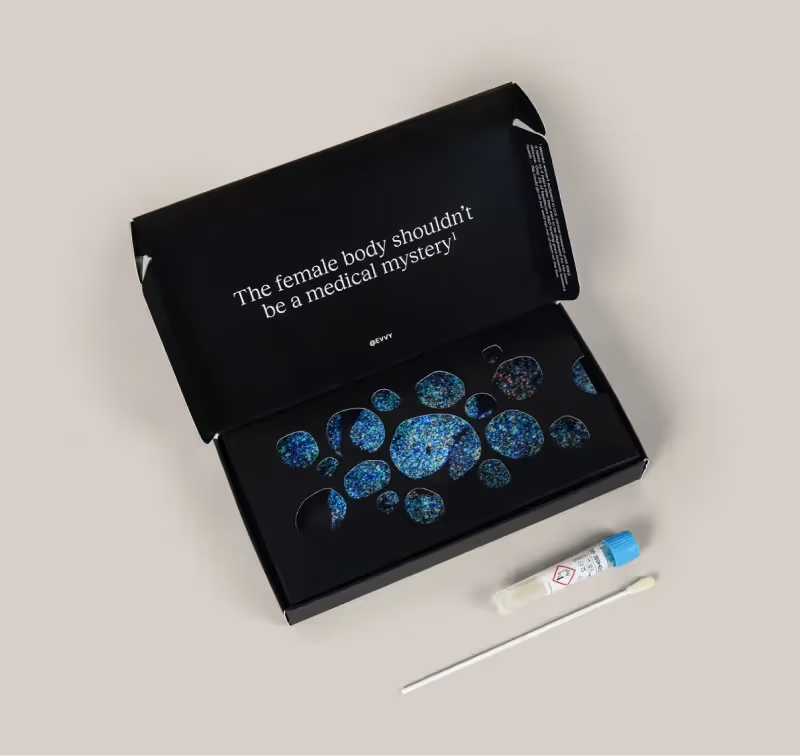
Recurrent symptoms? Get Evvy's at-home vaginal microbiome test, designed by leading OB-GYNs.
Kidney stones are solid masses of crystals that form in the kidneys, often made up of substances like calcium, oxalate, and uric acid, and can cause severe pain when they move into the urinary tract.
Symptoms of kidney stones include severe cramping pain that may radiate from the back to the lower abdomen or groin, while UTIs typically cause a burning sensation during urination and frequent urges to urinate.
Kidney stones vary wildly in size. Some are so tiny you don’t even know you are passing them. Some are small enough to pass on their own, but are still unpleasant. Others grow large enough to get stuck in your urinary tract, causing severe pain and potentially requiring medical intervention.
Unlike UTIs, kidney stones aren't caused by bacteria. They're a structural issue, not an infection. That said, UTIs can lead to the formation of struvite stones, which are large stones that can fill the renal pelvis and are caused by urea-splitting bacteria.
Kidney stones can also increase your risk of getting a UTI because a stone blocking your urinary tract creates conditions where bacteria can thrive.
UTIs and kidney stones can create a cycle where each condition can exacerbate the other, with approximately 18% to 36% of patients experiencing both simultaneously. It's another reason why treating UTIs promptly matters.
There’s definitely some overlap in symptoms, but some fairly clear signals point toward one condition over the other.
UTI pain tends to be dull and achy, concentrated in your lower abdomen or pelvic area. It's uncomfortable, but it usually doesn't stop you in your tracks.
Kidney stone pain is a different story. It's often described as one of the most intense types of pain a person can experience — sharp, severe, and cramping. You'll typically feel it in your back or side, just below your ribs (called flank pain), and it may radiate down toward your groin or inner thigh as the stone moves through your urinary tract. The pain often comes in waves, intensifying and easing as the stone shifts.
If the pain is making you double over, or you can't get comfortable no matter what position you try, that's more likely kidney stone territory.
Both conditions mess with your urinary habits, but in distinct ways. With a UTI, urinary symptoms are often the loudest complaint. You'll likely notice a frequent, urgent need to pee (even when your bladder is almost empty). Peeing usually burns or stings, and you may notice cloudy or strong-smelling urine.
With kidney stones, urinary symptoms can appear too, especially if the stone has traveled down into your ureter or bladder. You might notice blood in your urine (pink, red, or brown-tinged), feel the urge to pee more often, or experience pain or discomfort while peeing. But the defining symptom is that intense, colicky flank or back pain. The urinary changes tend to be secondary to that.
Blood in the urine can occur with both conditions, so it's not a reliable differentiator on its own.
A low-grade fever can show up with a UTI, especially if the infection has started to move toward your kidneys. Nausea and vomiting are less common with a straightforward bladder UTI.
With kidney stones, nausea and vomiting are actually very common, and often significant. The severity of the pain triggers the same kind of physiological stress response that causes vomiting in other acute pain situations.
A fever alongside kidney stone symptoms, however, is a red flag that could indicate an infection has developed around the stone. That combination needs emergency care immediately.
The testing pathways for these two conditions are completely different, and it matters to know what you're working with before you start treating anything. The main difference is that a UTI diagnosis typically involves a urinalysis to detect bacteria and white blood cells, whereas kidney stones are diagnosed with imaging tests such as CT scans or ultrasounds.
At-home UTI dipstick tests check your urine for leukocytes (white blood cells) and nitrites, two markers that indicate an infection. They're widely available at pharmacies and can give you a quick result. The catch is that dipsticks have a meaningful false negative rate, meaning they can miss a real UTI, particularly one caused by certain bacteria that don't produce nitrites.
For more accurate results, Evvy's UTI+ Test uses PCR (polymerase chain reaction) technology to detect the specific bacteria causing your infection (the same method used in clinical labs). It can also pick up pathogens that most standard urine cultures miss, so you get a fuller picture of what's actually going on. That matters because knowing which bacteria are responsible means your provider can prescribe the right antibiotic rather than guessing. It's a smarter first step than a dipstick test, especially if you've had UTIs that didn't respond to standard treatment.
Kidney stones can't be confirmed at home because diagnosing them requires medical imaging tests. The gold standard is a CT scan (specifically a non-contrast CT of the abdomen and pelvis), which can detect stones of almost any size and location. An ultrasound is a lower-radiation alternative often used for initial screening, especially in pregnant women.
Your doctor may also run a urinalysis and blood tests to check for infection markers and assess kidney function. If you pass a stone, they may ask you to collect it so a lab can analyze its composition to help prevent future stones. For example, in struvite stones, medications such as acetohydroxamic acid (AHA) may be prescribed to inhibit bacterial growth that contributes to stone formation.
Once you know what you're dealing with, treatment is usually straightforward, though the path looks different depending on whether it's a UTI or kidney stones.
UTIs are treated with antibiotics. The type and duration depend on the bacteria involved and whether the infection is confined to your bladder or has spread to your kidneys. Most uncomplicated bladder UTIs clear up within a few days of starting treatment.
If you test with Evvy, an affiliated provider will review your results and, if eligible, prescribe targeted treatment for your UTI. You may even qualify for same-day prescription pickup at your local pharmacy (and you can use insurance to cover the cost of treatment).
UTIs very rarely go away on their own. Waiting it out or relying solely on over-the-counter treatment to manage symptoms can mask the infection without clearing it, giving bacteria time to spread upward to your kidneys. A kidney infection is significantly more serious, often requiring IV antibiotics or hospitalization. All that to say that getting tested and treated promptly really matters.
Treatment depends on the stone's size and location. Small kidney stones often pass on their own with plenty of fluids, rest, and over-the-counter pain relief. Your doctor may prescribe medication such as tamsulosin to relax the ureter and help the stone pass more quickly.
Larger kidney stones that won't pass on their own may need medical intervention:
If your stone is causing a blockage or is accompanied by infection, treatment becomes more urgent.
Though it won't treat either, staying well hydrated is the most effective prevention strategy for both kidney stones and UTIs, as it helps dilute urine and flush bacteria from the urinary tract.
Some symptoms require emergency evaluation, regardless of whether you think it's a UTI or a kidney stone. Seek medical attention if you experience:
These symptoms can indicate a kidney infection, an obstructed urinary tract, or a stone with a secondary infection, all of which need urgent care. Don't wait to diagnose yourself at home; see a doctor immediately.
Yes, absolutely. Both can cause pelvic pain, frequent urination, and changes in your urine. The key difference is that kidney stones can cause symptoms like nausea, vomiting, and blood in the urine, while UTIs may cause systemic symptoms such as fever and chills if the infection spreads to the kidneys. A proper test is the only way to know for sure.
It can. As a stone travels through the ureter toward the bladder and urethra, it can cause a burning sensation when you pee, urgency, and even visible blood in your urine (all symptoms that overlap with a UTI). In some cases, a stone can also trigger a UTI, so you may actually be dealing with both at once.
The most common warning signs are: a sharp, intense pain in your back or side below the ribs; pain that radiates to your lower abdomen or groin; blood in your urine (pink, red, or brown); nausea and vomiting; and pain or a burning sensation when you pee. Fever and chills can also occur if a secondary infection develops.
You can test for a UTI at home. Evvy's UTI+ Test uses PCR technology to identify the bacteria causing your infection, giving you and your provider the information needed to treat it correctly. Kidney stones, however, require medical imaging to diagnose, so there's no reliable at-home test for them. If your symptoms are severe or you're experiencing significant back or flank pain, contact your doctor or go to urgent care rather than relying on home testing alone.