CONGRATS! YOU EARNED FREE SHIPPING.

Product Title
1
$0
$0
Subscription Title

Looking kind of empty in here.
We recommend:
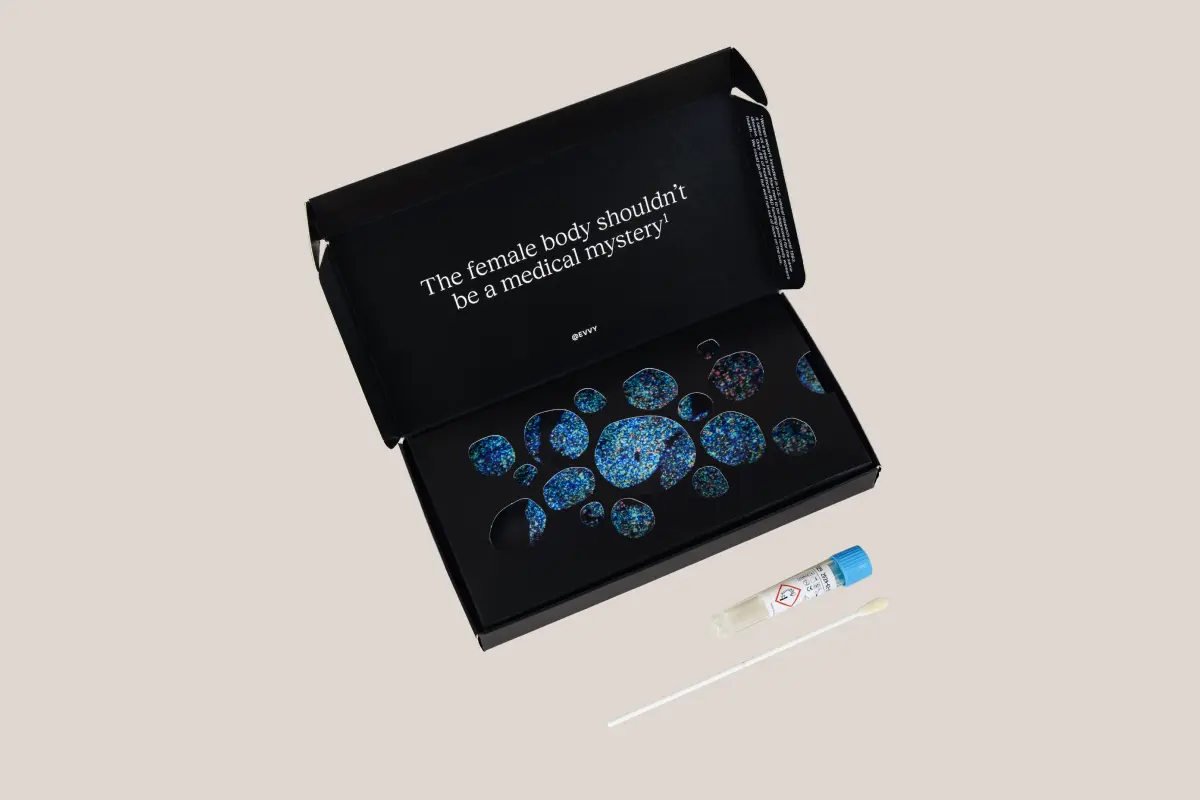
Get advanced insights into symptoms, fertility, and other health outcomes. Prelim results in 1-3 days.

Dipstick tests screen for UTI signals. Evvy's PCR test identifies the exact pathogen and resistance genes. Here's how they compare and when each makes sense.
Words by Olivia Cassano
Scientifically edited by Dr. Krystal Thomas-White, PhD
Medically reviewed by Dr. Kate McLean MD, MPH, FACOG
If you've ever tested negative on a home UTI strip while your symptoms told a different story, or tested positive but still ended up on an antibiotic that didn’t work, it doesn’t necessarily mean the strip failed. It may have simply addressed a different question than the one you were asking.
Home UTI dipstick tests are designed to detect two indirect chemical signals that may suggest a urinary tract infection (UTI). They don't identify bacteria, can't tell you which organism is involved, and have no way of knowing whether the antibiotic your doctor is about to prescribe will actually clear it. Evvy's UTI+ Test, on the other hand, can. It's a lab-based urine PCR test that detects the genetic material of specific infection-causing organisms, alongside antibiotic resistance genes that tell a provider which treatment is most likely to work from the start.
Keep reading to learn more about the differences between Evvy’s UTI+ Test and UTI test strips.
UTI test strips are a screening tool. Rather than detecting bacteria, they look for chemical markers in urine that tend to appear when the urinary tract is under stress from infection (white blood cells, nitrites, and sometimes pH). The result tells you whether those signals are elevated, not what's causing them or whether the cause is bacterial at all.
That makes strips useful in the right circumstances, and genuinely limited in others. Understanding what each marker actually represents is the first step to interpreting your results accurately.
The leukocyte pad detects leukocyte esterase, an enzyme released by white blood cells when they break down in urine. A positive reading suggests your immune system has been sending white blood cells to the urinary tract, which is a sign of inflammation. But inflammation doesn't always mean a bacterial infection is present. Conditions like interstitial cystitis, vaginitis, and urethritis can elevate leukocyte esterase without a true UTI, so a positive leukocyte esterase result on its own doesn't confirm a bacterial infection in your bladder that needs antibiotics.
The nitrite pad on the UTI test strip detects a substance produced when certain bacteria naturally convert nitrates in urine. A positive nitrite result usually indicates the presence of gram-negative bacteria, most commonly E. coli, which is responsible for many uncomplicated UTIs. However, some common bacteria that cause UTIs, such as Staphylococcus saprophyticus, Enterococcus, and Candida albicans, don’t produce nitrites at all. This means the test can show a negative result even if an infection is present. Also, for the nitrite test to work, the bacteria need enough time to convert the nitrates, which typically takes at least four hours. So, testing too soon after peeing can give a false negative, regardless of the type of bacteria.
A strip result that doesn't match your symptoms usually has an identifiable cause. The most common include:
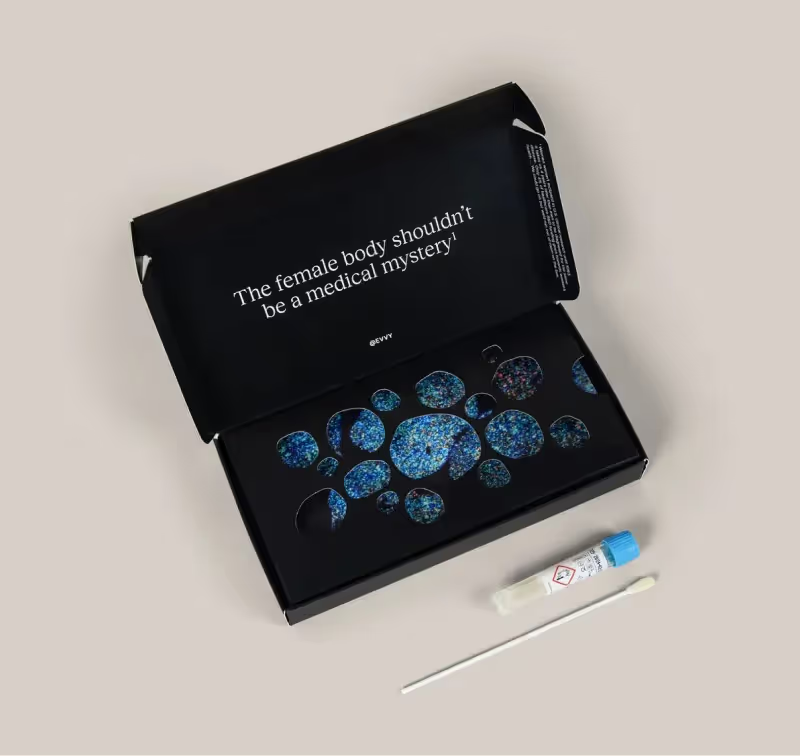
Recurrent symptoms? Get Evvy's at-home vaginal microbiome test, designed by leading OB-GYNs.
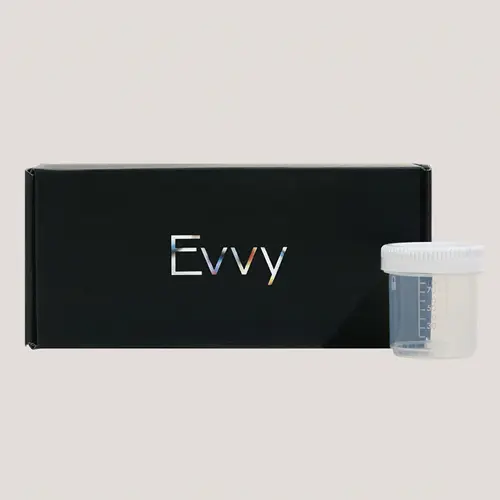
Evvy's UTI+ Test uses polymerase chain reaction (PCR) technology (the same method used in high-sensitivity clinical and research settings) to detect the genetic material of specific pathogens directly from your urine sample. Instead of looking for inflammation markers, it analyzes the DNA of known UTI-related bacteria present in this sample.
The result is a lab report that lists the specific organisms detected, along with any antibiotic resistance genes found. A provider reading your Evvy results knows which organism is responsible and which antibiotic resistance genes are present, which means they can prescribe a targeted treatment from the start rather than making an educated guess.
Evvy's UTI+ Test screens for 12 uropathogens — including E. coli, Klebsiella pneumoniae, Candida albicans, Mycoplasma hominis, Ureaplasma urealyticum, and Staphylococcus saprophyticus — and seven antibiotic resistance genes covering resistance to quinolones, trimethoprim/sulfamethoxazole, vancomycin, and more. Results are returned within 1 business day after the sample reaches the lab. The test is also FSA- and HSA-eligible, so you can reimburse the cost of the test.
It’s worth unpacking what "accurate" actually means for each type of test, because they don't measure the same things, and comparing them directly can be misleading.
A dipstick result that's positive for leukocyte esterase and nitrite is a good signal that something is happening in the urinary tract, but it doesn't confirm infection, identify an organism, or tell you whether an antibiotic will work.
The leukocyte esterase test suggests inflammation, while the nitrite test suggests the presence of bacteria in your urine. Together, they can raise or lower the probability of a UTI, but they can't diagnose one. A positive strip result means inflammatory markers are elevated, not that a specific bacterium has been identified or that a particular antibiotic will clear it.
PCR testing checks for the genetic material of a specific pathogen in a sample. If the test detects an organism associated with your symptoms, your provider can use this result to treat you effectively. The accuracy of PCR testing depends on several factors: how well the sample is collected (ideally a clean catch of first morning urine), whether the organism causing your symptoms is included in the test panel, and whether there are enough bacteria in the sample to detect. Like any test, PCR works best when used correctly and when the results are considered along with your symptoms.
Most useful when:
Less useful when:
Recurrent UTIs (typically defined as three or more within a year) often require a different testing approach than a first-time infection, because standard tests aren't always giving you the full picture.
A dipstick is useful for a quick check when symptoms flare, but as explored above, it misses organisms that don't produce nitrites and can't tell you whether resistance is a factor. A urine culture (the test most doctors order) is the traditional step up from a dipstick. It can identify the causative organism and sensitivity pattern, but standard cultures can take several days to return results and miss up to 70% of pathogens. When a UTI is missed or treated with the wrong antibiotic (which happens to one in two women), the infection can spread, and an untreated UTI that reaches the kidneys can develop into pyelonephritis, a serious infection that often requires urgent medical care.
For someone in a cycle of recurrent UTIs, Evvy's approach offers something different. PCR testing can detect organisms that cultures miss, returns results within one business day, and — critically — includes antibiotic resistance markers as a standard part of the report. If a previous antibiotic didn't clear the infection, your Evvy results may explain exactly why.
A practical approach for recurrent symptoms may be:
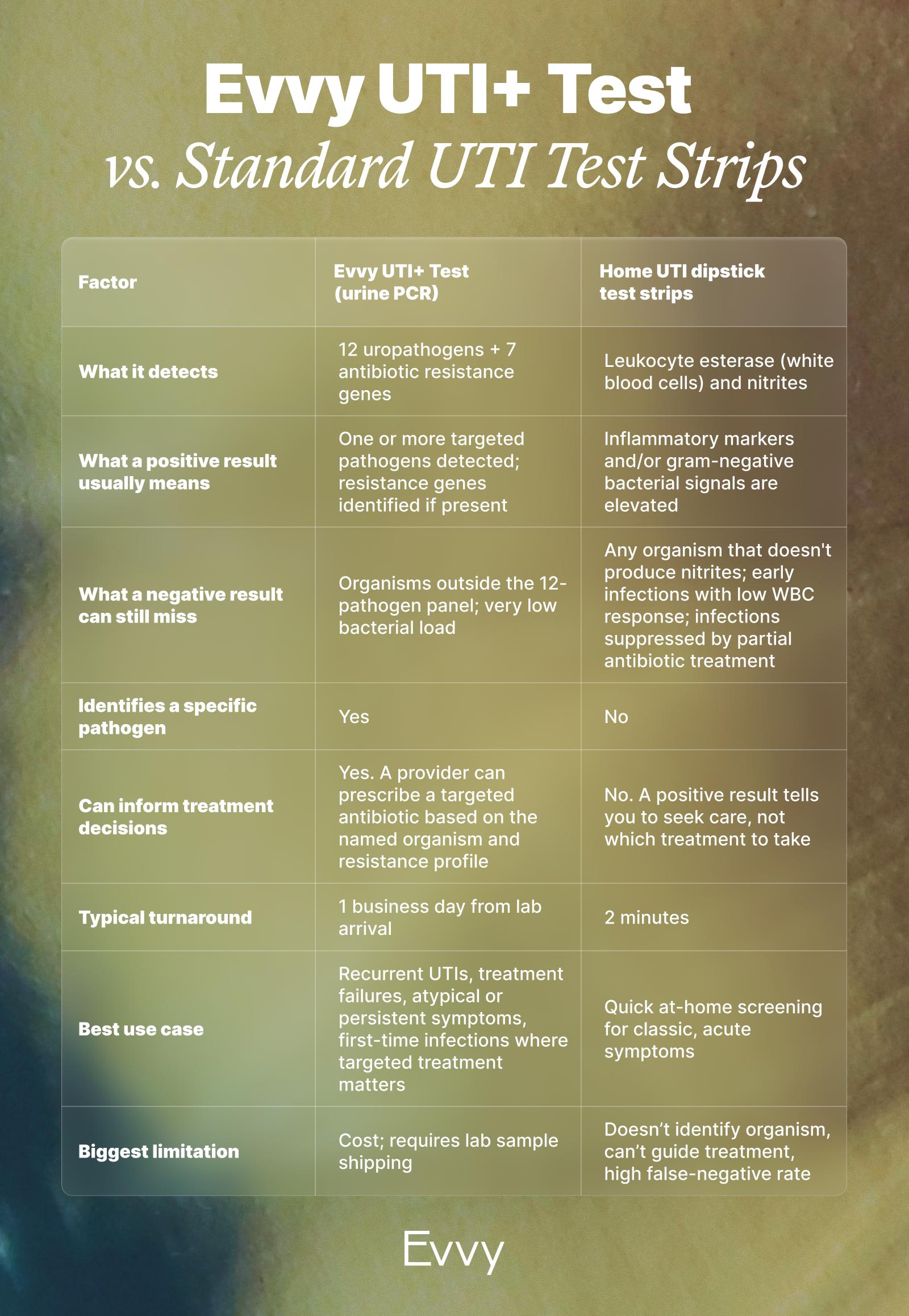
Yes. Evvy's UTI+ Test is a comprehensive at-home UTI test that screens for 12 uropathogens and seven antibiotic resistance genes using PCR technology. It's designed to detect what standard urine cultures and dipstick tests commonly miss and returns results within one business day after the sample arrives at the lab. If eligible, you can receive a same-day prescription pickup through Evvy's affiliated providers based on your results.
Evvy's UTI+ Test uses PCR technology to detect pathogen DNA directly rather than relying on indirect chemical markers. This approach is more sensitive than traditional urine cultures, which can miss up to 70% of pathogens, and more specific than dipstick tests, which can only signal that inflammation or gram-negative bacteria may be present. As with any test, accuracy is best supported by a clean-catch sample collected correctly.
They serve different purposes. Test strips are a screening tool, so they can't identify the organism, explain a treatment failure, or guide antibiotic selection. Evvy's UTI+ Test provides organism-level identification and resistance profiling, which is what diagnosis and treatment actually require. For a first-time, uncomplicated infection, a strip can be a useful first sign. For anyone with recurrent infections, an atypical presentation, or a history of antibiotics that didn't work, Evvy provides more useful information in a meaningful way.
For recurrent UTIs, test strips are most useful as a quick check during an acute flare to help you decide whether to seek care today. Evvy is more useful when you need to understand what's actually driving the recurrence: which organism is responsible, whether resistance is contributing to treatment failures, and — when paired with the Vaginal Health Test — whether your vaginal microbiome may be seeding repeat infections. If you've had more than one UTI in six months, Evvy gives you the kind of information that can break the cycle rather than just treat the next infection.
Dipstick tests and PCR tests measure different things. A dipstick test checks for chemical signals that can change based on factors like hydration, timing, contamination, and the type of organism. In contrast, a PCR test looks for genetic material. If Evvy finds a pathogen that a dipstick missed, it's usually because the organism doesn’t produce nitrites, like S. saprophyticus, Enterococcus, or Candida. It could also be because the number of bacteria was too low for the dipstick to detect. If Evvy is negative but the dipstick shows positive, it might mean that the elevated leukocyte esterase was caused by something other than bacteria.
The main options for testing UTIs are urine culture, PCR-based urine testing (like Evvy's UTI+ Test), and clinical urinalysis with microscopy. Urine culture is the standard lab test that most doctors use, but it can take a few days and might miss many types of bacteria. PCR testing is faster and more accurate. It also checks for antibiotic resistance, making it the best choice for people with recurrent or hard-to-treat UTIs. For those who prefer to get thorough results from home without visiting a doctor, Evvy's UTI+ Test is currently the best at-home option available.